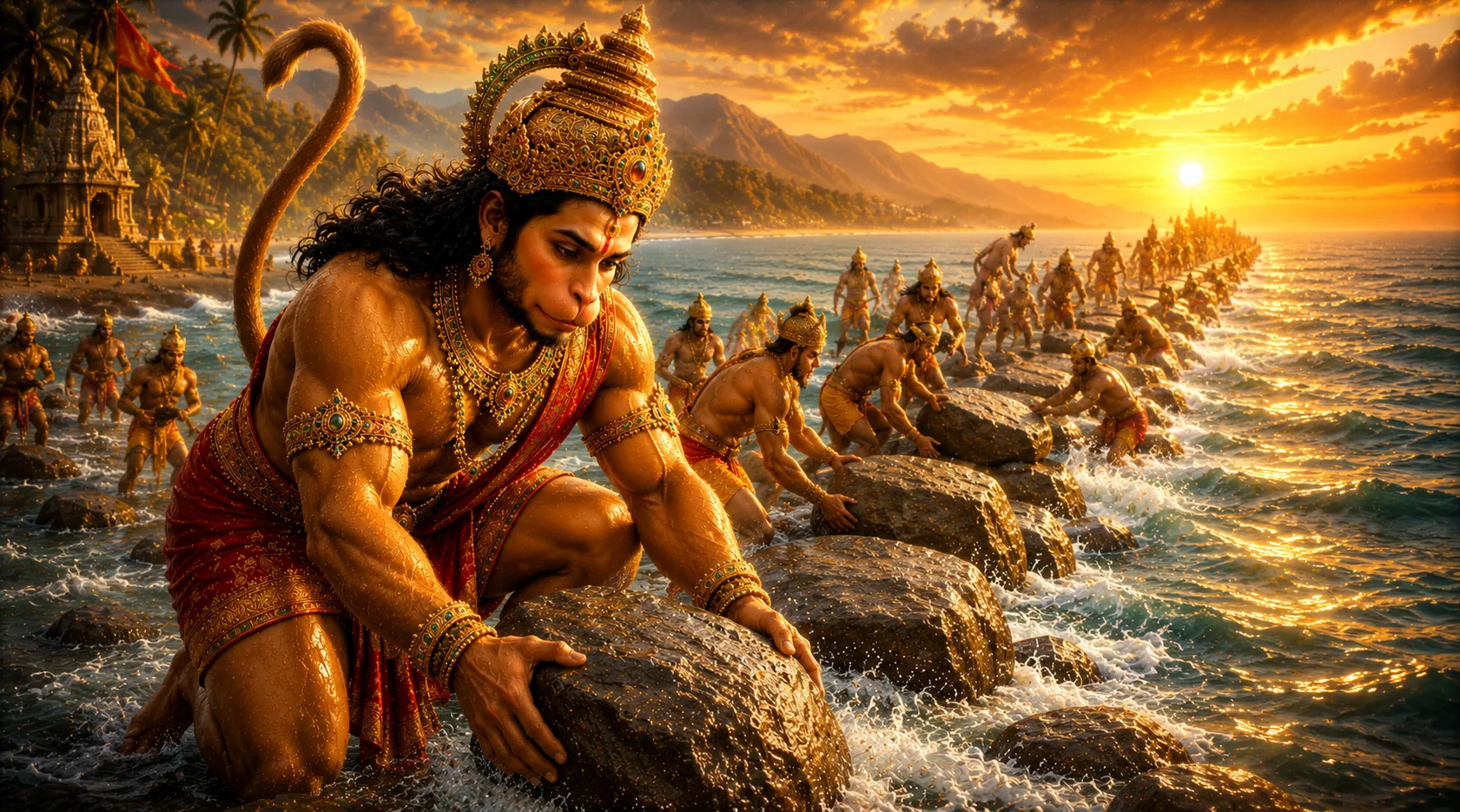
Building the Ram Setu
When Rama's army of vanaras reaches the vast ocean on their way to Lanka, they find themselves helpless. Rama prays to the ocean god Samudra for three days but receives no answer. In frustration, he raises his bow to strike the sea, and Samudra finally appears, revealing that the vanaras must build a bridge using floating stones inscribed with Rama's name. With Nala and Neela as architects and the entire army working together, the Ram Setu is completed in five days, and Rama marches into Lanka.
Characters
The Indian Ocean stretched before them like an endless blue kingdom. Its waves rose and fell with a rhythm older than time itself, crashing against the shore with a sound that seemed to say, "You shall not pass." On the golden sands of the coastline stood the army of Lord Rama — thousands upon thousands of vanaras, the monkey warriors, their fur glistening in the tropical sun. They had marched across the entire length of India, through forests and over mountains, driven by love and loyalty and the burning desire to rescue Sita. But now their journey had come to a halt. Before them lay the ocean, vast and unconquerable. Beyond those treacherous waters, in a city of gold guarded by the ten-headed king Ravana, sat Sita, waiting for her lord.
Rama stood at the water's edge, his eyes fixed on the horizon. He was no ordinary prince. He was the seventh avatar of Lord Vishnu, born on Earth to vanquish the forces of darkness. But in this moment, standing before the endless ocean, he was simply a husband desperate to reunite with his beloved wife. His bow, the mighty Kodanda, rested in his hand. His quiver was full of arrows that had never missed their mark. Yet how could arrows fight the sea?
Beside him stood Lakshmana, his devoted younger brother. Lakshmana had followed Rama into exile without hesitation, leaving behind a life of comfort and luxury. His loyalty was as steady as the Himalayas themselves. He had not slept properly in fourteen years, choosing instead to guard his brother day and night. Now he looked at the ocean with barely concealed frustration.
"My brother," Lakshmana said, "we have crossed forests and climbed mountains. We have made allies of bears and monkeys. We have faced demons and survived. But this ocean... how do we cross this?"
Rama did not answer. He knelt down and touched the water with his fingertips. The salt water was warm against his skin. He closed his eyes and began to pray.
Nearby, Hanuman sat on a large rock, watching his lord with devotion shining in his eyes. Hanuman had already proven his incredible strength when he leaped across the ocean to find Sita in Lanka. But even Hanuman could not carry the entire army across. The vanara king, Sugriva, paced back and forth, discussing strategies with his ministers. The bear king Jambavan sat calmly, stroking his grey beard, his ancient eyes carrying the wisdom of ages.
And among the crowd of vanaras stood two who would soon become legendary — Nala and Neela. They were not the strongest or the fastest. They were not the fiercest fighters. But they were the sons of the divine architect Vishwakarma. They possessed the knowledge of construction, the mysteries of engineering, the art of building structures that could stand against any force. But for now, even Nala and Neela felt helpless. What could they build without any materials at all?
The sun began to set, painting the sky in shades of orange and pink. The vanaras built campfires along the shoreline. The sounds of the jungle filled the night — crickets, frogs, the distant call of an owl. And through it all, Rama continued to pray.
He prayed for one day. Then two days. Then three days.
On the third day, Rama sat on a bed of grass near the shore, his eyes still closed, his lips still moving in silent prayer. The ocean crashed against the shore, indifferent to his pleas. The waves rose and fell as they had for millions of years, carrying no message, offering no path.
Lakshmana could bear it no longer. He stormed toward the water, his hand on his sword.
"O ocean!" he shouted. "My brother has prayed to you for three days and three nights. He is no ordinary man. He is the lord of the universe himself. And yet you refuse to answer. If you do not show yourself and offer us a way, I will dry up your waters with my arrows."
The ocean did not respond. The waves continued their endless dance.
Rama opened his eyes. His patience, which had been as deep as the ocean itself, finally reached its limit. He stood up slowly, his joints aching from three days of stillness. He picked up his bow and nocked an arrow. His eyes burned with a fire that had nothing to do with anger and everything to do with determination.
"If you will not listen to prayer," Rama said, his voice calm but carrying immense power, "then you will listen to force."
He drew back his bowstring. The air around him began to tremble. The vanaras fell silent. The birds stopped singing. Even the wind seemed to hold its breath. The arrow on Rama's bow was no ordinary arrow — it was an astra, a divine weapon blessed by the gods themselves. If released, it would split the ocean apart, creating a path of dry land all the way to Lanka. But it would also destroy the ocean's ecosystem, killing countless creatures and disrupting the balance of nature.
Just as Rama was about to release the arrow, the ocean began to churn. The waves rose higher than the tallest tree. A great whirlpool formed in the distance. From the depths of the sea, a figure emerged — tall and majestic, his body made of shimmering water, his beard flowing like a waterfall, his crown studded with pearls and corals. It was Samudra, the god of the ocean.
"Stop, O Rama!" Samudra cried, raising his hands. "Please, do not release that arrow."
Rama held his position, the bow still drawn. "Why should I stop?" he asked. "I prayed to you for three days. I asked for your help. I begged you for a path across your waters. And you ignored me. Now you appear when I raise my weapon. Is that the only language you understand?"
Samudra bowed his head in shame. "Forgive me, Lord. I knew you were praying. I heard every word. But I could not answer. You see, the ocean has its own nature, its own dharma. I cannot simply part my waters for you, no matter how much I wish to. If I did, the world would fall out of balance. The rivers would flood. The rains would cease. The very cycle of life would be broken."
Rama lowered his bow slightly but did not relax. "Then what am I to do? My wife is in Lanka. Ravana has kidnapped her. I must cross this ocean to rescue her. If you cannot part, then I will find another way."
Samudra smiled. "That is exactly what you must do, Lord. Find another way. I cannot part, but I can help. Listen carefully."
The ocean god leaned closer and spoke in a voice that only Rama could hear. "There is a secret known only to the gods. In the northern mountains, there is a special stone that has been blessed by the sun. When you write the name of the divine upon these stones, they will not sink. They will float upon my waters like boats. Gather these stones. Write the name of Rama upon them. Build a bridge across my waters."
Rama's eyes widened. "A bridge of floating stones?"
"Yes," said Samudra. "The vanaras are strong and skilled. Among them are Nala and Neela, the sons of Vishwakarma. They will guide the construction. The monkeys can carry the stones. The bears can help shape them. Together, you can build a bridge that will span the ocean. And I promise you this — my waters will not rise against your bridge. The waves will calm wherever your builders work. The sea creatures will not disturb you. Complete the bridge, and you shall cross into Lanka."
Rama slowly lowered his bow. He looked at Samudra with gratitude and respect. "Thank you, Lord of the Ocean. Your help will not be forgotten."
Samudra bowed and began to sink back into the water. "One more thing, Rama," he said before disappearing. "The bridge must be built with faith. Every stone that carries your name will be protected. But if a stone is thrown without faith, it will sink. Trust in your army. Trust in yourself. Trust in the divine."
With that, Samudra vanished beneath the waves, and the ocean returned to its peaceful rhythm.
Rama turned to face his army. The vanaras were watching him with eager eyes. He raised his hand and called out, "My friends! The ocean has given us a way. We will build a bridge across these waters — a bridge so mighty that it will be remembered for thousands of years."
The vanaras erupted in cheers. They had spent three days doing nothing, and they were restless and eager. Now they had a purpose.
Nala and Neela stepped forward. "My lord," Nala said, "we are the sons of Vishwakarma. We know how to build. Give us the plan, and we will execute it."
Rama placed his hands on their shoulders. "You will be the chief architects," he said. "You will design the bridge and direct the workers. But remember — every stone must carry the name of Rama. That is what will make them float."
So the work began.
Vanaras were sent to the mountains to gather stones. They climbed steep slopes and rolled boulders down to the base. Other vanaras picked up the boulders, some of them larger than the monkeys themselves, and carried them to the shore. Every single stone was inscribed with the sacred name: Ram.
"He writes the name of the lord," one vanara said to another as he carved the letters into a stone.
"With faith," the other replied.
Nala and Neela designed the bridge with remarkable precision. They used their divine knowledge to calculate the right width, the right height, the right angle. The bridge would be built in five sections, each one leading closer to Lanka. The first section was the easiest, close to the shore. The middle sections would be the hardest, requiring deeper foundations and stronger stones. The final section would be built in shallow waters near Lanka.
The vanaras worked without rest. They formed long chains, passing stones from hand to hand. They sang songs as they worked, their voices carrying across the water. The bears helped by breaking large boulders into smaller pieces. Even the monkeys who usually caused mischief found purpose in the work.
Hanuman was everywhere at once. He carried the largest stones, sometimes lifting boulders that a hundred monkeys together could not move. He encouraged the workers when they grew tired. He carried messages between Nala and Rama. His energy seemed endless, his devotion fueling every step.
Rama himself joined the work. He did not stand aside and watch. He waded into the water, placing stones with his own hands. He encouraged the vanaras, shared their meals, and slept on the beach beside them. His presence gave the army strength.
On the first day, a long causeway stretched from the shore into the shallow waters. The vanaras cheered as they saw the bridge taking shape. Stones that should have sunk to the bottom floated on the surface, bobbing gently in the water.
On the second day, the bridge reached deeper waters. Nala and Neela adjusted the design, making the bridge wider and stronger. Some vanaras fell into the water, but others caught them. Nobody gave up.
On the third day, the bridge seemed to stretch all the way to the horizon. The vanaras worked through the night, lighting torches along the bridge. From a distance, it looked like a line of stars leading into the darkness.
On the fourth day, the bridge crossed the deepest part of the ocean. The waves were higher here, and the current was strong. But the stones held. The name of Rama kept them afloat. The vanaras worked with renewed determination.
On the fifth day, the final stone was placed. The last section of the bridge touched the shores of Lanka. A great roar went up from the vanara army — a cheer so loud that it was heard in the palace of Ravana himself.
The Ram Setu, Rama's Bridge, was complete.
Rama stood at the head of the bridge, looking across at the island of Lanka. His heart swelled with gratitude — for his army, for Nala and Neela, for Hanuman, for Samudra, and for the divine grace that had made the impossible possible.
"My friends," Rama said, turning to face the vanaras. "You have done what no army has ever done. You have built a bridge across the ocean. Not with magic, but with faith and hard work. Remember this always — when you have faith and when you work together, no obstacle is too great."
The vanaras cheered again. Lakshmana stood beside his brother, a rare smile on his face. Hanuman knelt before Rama, his eyes filled with tears of devotion.
And so, Lord Rama crossed the Ram Setu with his mighty vanara army, ready to face Ravana and rescue Sita. The bridge that they built that day still exists, even now, in the waters between India and Sri Lanka. It stands as a reminder for all time that faith moves mountains — and builds bridges across oceans.
✦Moral of the Story
Faith and determination can overcome even the greatest obstacles when we refuse to give up
When people work together with a common purpose, they can achieve what once seemed impossible
Prayer and action must go hand in hand — divine grace blesses those who combine devotion with effort
Loved This Story?
Read 100+ more sacred Hindu kathas with professional audio narration in both English & हिन्दी on the Tattva app — free, no subscription, no IAP.
Get on Google Play