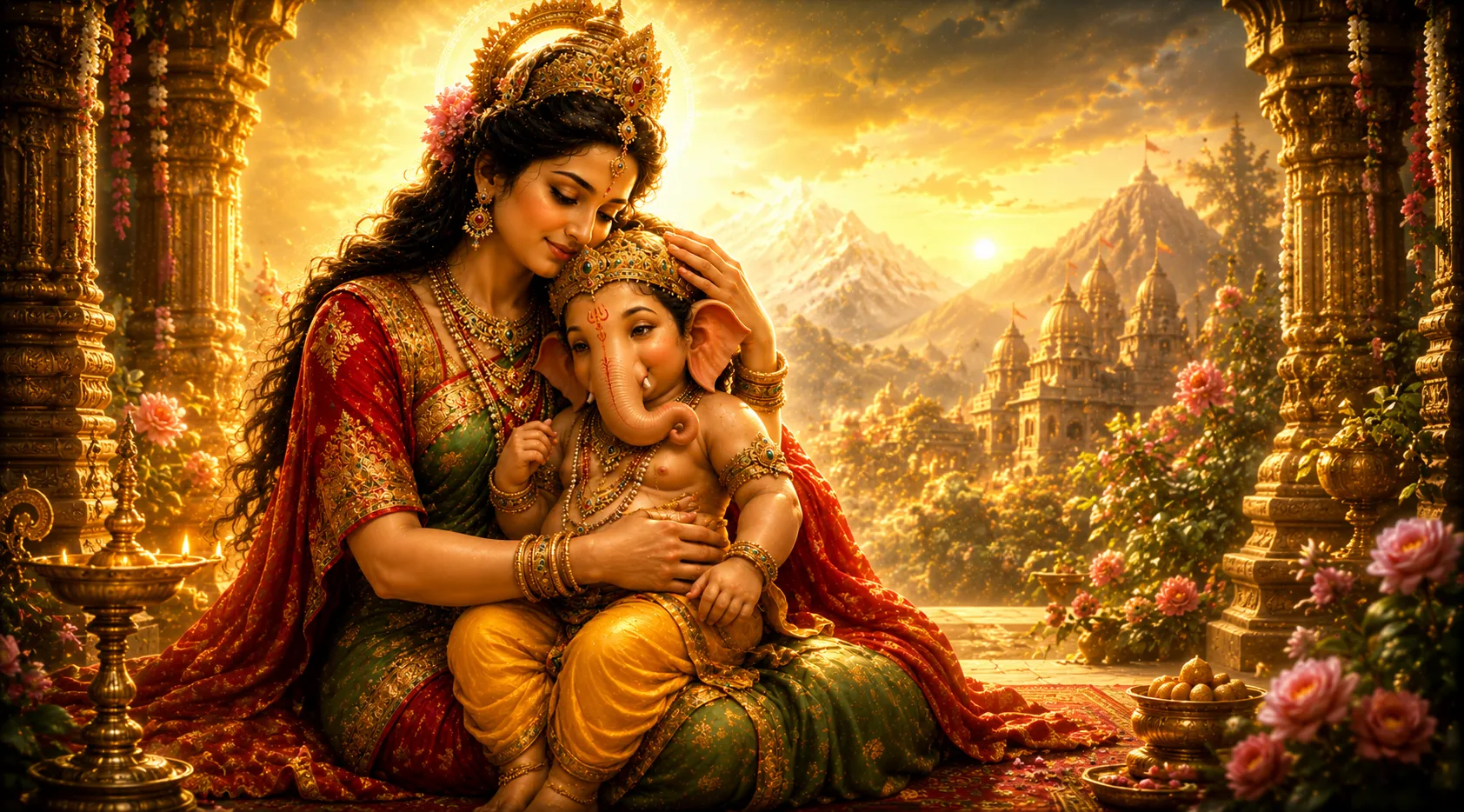
Birth of Ganesha
Goddess Parvati, longing for companionship on Mount Kailash, creates a son named Ganesha from turmeric paste and breathes life into him. When Lord Shiva returns and is stopped by Ganesha from entering Parvati's chambers, a confrontation ensues that leads to a terrible mistake, a mother's grief, and a divine act of restoration that gives Ganesha his elephant head and makes him the beloved lord of all beings.
Characters
On the peaceful slopes of Mount Kailash, where snow rests like a soft blanket and the silence of deep meditation fills the air, Goddess Parvati sat alone in her chambers. The mountain, though magnificent, felt vast and empty without the presence of her beloved. Lord Shiva, her husband and the lord of all creation, had gone deep into the forests for his long meditations, as was his nature. Days turned into weeks. Weeks stretched into months. Parvati watched the clouds drift past her window, listened to the wind whistle through the peaks, and felt a longing she had never known before.
She walked through the grand halls of Kailash, past the crystal walls that shimmered with divine light, past the gardens where celestial flowers bloomed in every color. Everything was beautiful. Everything was perfect. And yet something was missing. The goddess, who had the power to create and nurture entire worlds, felt a simple and deeply human ache. She wanted companionship. She wanted someone to love, someone to call her own, someone who would fill the silence with laughter and chatter and life.
One afternoon, as the golden sun bathed the mountains in warm light, Parvati sat by the river that wound gently near her home. She dipped her hands into the cool water and then noticed a small lump of turmeric paste that had fallen from her arm. The paste was warm and soft, glowing like the sun itself. An idea began to bloom in her mind. A beautiful, wonderful, impossible idea that made her heart beat faster.
With tender care, she gathered the turmeric and began to work it in her fingers. She shaped it the way a sculptor shapes clay, but her tools were love and longing. She formed sturdy little legs and small arms. She shaped a round face with cheeks that begged to be pinched. She created bright eyes that seemed to sparkle even before they could see. Every curve, every line, every detail was crafted with the devotion of a mother who already loved her child before he even existed.
When she was finished, she held the figure in her palms. It was a young boy, perfect in every way. Parvati looked at him and felt a warmth spread through her chest, a feeling she had never experienced before. She brought the figure close to her lips and breathed into it the breath of life.
The boy stirred. His tiny chest rose and fell. His eyelids fluttered and then opened. He looked up at Parvati with eyes that were deep and knowing and innocent all at once. And then he smiled.
"Mother," he said. His voice was soft and clear, like a bell ringing for the first time.
Parvati's heart overflowed. Tears of joy streamed down her face. She gathered him in her arms and held him close, feeling the warmth of his body against hers. "You are my son," she whispered, her voice trembling with emotion. "I name you Ganesha. You are the lord of my heart."
From that moment, Kailash was no longer a silent mountain. It was alive. Ganesha filled every corner with his laughter, his endless questions, his boundless curiosity. He ran through the halls, his tiny feet pattering against the marble floors. He played in the gardens, chasing butterflies and talking to the flowers. He sat beside his mother as she prepared meals, watching her every move and learning from her every word. He asked about the stars, the rivers, the animals, the gods. And Parvati answered every question with patience and love.
"Mother, why is the sky blue?" he would ask.
"Because the universe loves color, my son," she would reply.
"Mother, do the mountains ever feel lonely?"
"Not anymore," she would say, pulling him close. "Not since you came."
Days passed in a blur of happiness. Parvati felt complete. The silence that had once haunted her was now filled with the music of her son's presence.
One afternoon, Parvati decided to bathe in her private chambers by the waterfall. She called Ganesha to her side and knelt so that her eyes were level with his. "My dear son," she said, placing her hands gently on his shoulders, "I need you to do something very important. I am going to bathe, and I must not be disturbed. Will you guard the door for me? Will you make sure that no one enters until I am finished?"
Ganesha straightened his back. His small face became serious. He nodded with great determination. "Do not worry, Mother," he declared. "No one will pass while I am here. I promise."
Parvati smiled, kissed his forehead, and disappeared inside.
Ganesha took his position at the entrance. He stood with his feet apart, his arms crossed, his eyes fixed on the path ahead. He was small, but his heart was mighty. He had a duty. He had a promise to keep. And nothing in the world would make him break it.
Hours passed. The sun began its slow descent, painting the sky in shades of orange and pink. The mountain grew quiet. And then, from the distant path, a figure appeared.
He was tall and powerful, with matted hair flowing behind him like dark rivers. The crescent moon rested on his head. The sacred Ganga flowed through his locks. A trident gleamed in his right hand, and his third eye, though closed, radiated an energy that could shake the universe. Lord Shiva was returning from his meditation.
Shiva walked toward his home, his heart light and his mind peaceful. He was eager to see Parvati, to share the stillness he had found in the forest. But as he approached the entrance to the inner chambers, a young boy stepped into his path.
"Stop," said Ganesha, raising his hand. His voice was firm. "You cannot enter."
Shiva paused. He looked down at the child before him, curious and amused. "Who are you, little one?" he asked. "Do you not know who I am?"
"I am Ganesha," the boy said proudly. "And I know who you are not. This is my mother's home, and she is bathing. She asked me to guard the door, and I will not let anyone pass."
Shiva's smile faded. "Your mother?" he repeated. "Parvati is my wife. I am Shiva. This is my home as much as hers. Now let me pass."
Ganesha shook his head. "I do not care who you are. My mother said no one should enter. I made a promise. And I will keep it."
Shiva felt a flicker of irritation. He was not accustomed to being challenged, least of all by a child. "You are testing my patience," he said, his voice deepening. "Step aside, boy."
Ganesha did not move. His small feet were planted like roots on the mountain. His eyes did not blink. He had made a promise to his mother, and he would die before breaking it.
Shiva stepped back and turned to his ganas, the divine beings who served him. He gestured toward Ganesha. "Remove this boy from my path," he commanded. "Gently. He is only a child."
The ganas rushed forward, thinking the task would be easy. But what happened next astonished them all. Ganesha moved with a speed and strength that belied his size. He dodged their grasps. He swept them off their feet. He spun and blocked and countered every attack. One by one, the ganas fell, tumbling over each other in confusion. They could not lay a single finger on him.
The ganas retreated, humiliated and bewildered. Never had they seen such power in one so young.
Shiva's surprise turned to anger. He stepped forward, his eyes blazing with cosmic fire. "You have defeated my ganas," he said, his voice like thunder rolling across the sky. "But you will not defeat me."
Ganesha stood his ground. He was afraid, but he did not show it. He thought of his mother's face, of her smile, of the trust she had placed in him. And he found the courage to stand tall.
The confrontation that followed shook the very foundations of Kailash. Ganesha fought with everything he had, not out of anger, but out of love. He defended the door not as a warrior, but as a son protecting his mother's peace. But Shiva was the lord of destruction, and his power was beyond anything the young boy could withstand.
In a moment of divine fury, Shiva's trident swung through the air. Time seemed to stop. The birds fell silent. The wind held its breath.
And then there was silence. Complete and terrible silence.
Ganesha's body stood still for a moment, and then it crumpled to the ground. His head had been separated from it. The brave boy who had stood so tall was now still.
The fury drained from Shiva's face. He stared at the fallen child, and slowly, the realization of what he had done began to sink in. He had killed a child. A child who was only doing his duty. A child who had been brave and loyal and true.
At that moment, the door opened.
Parvati stepped out, fresh from her bath, a smile on her face. She looked at the scene before her and the world stopped. Her eyes moved from Shiva to the fallen ganas. And then they landed on the small body on the ground. The body of her son.
A cry escaped her lips. It was not a scream. It was something deeper, something more primal. It was the sound of a mother's heart breaking. She rushed to Ganesha and gathered him in her arms, holding him against her chest as if she could pour her own life into him.
"My son," she sobbed. "My beloved son. My Ganesha."
Shiva stood frozen. The lord of the universe, the destroyer of worlds, was helpless. He watched his wife weep over the child he had killed, and he felt something he had rarely felt in all his existence. Remorse. Deep, crushing remorse.
"Parvati," he said, his voice breaking. "I did not know. I did not know he was your son."
Parvati looked up at him. Her eyes were red, her face streaked with tears. "You did not ask," she said, her voice trembling. "You did not stop to listen. You saw only an obstacle. But he was not an obstacle, Shiva. He was a child. Our child. He was guarding me because he loved me. And you destroyed him."
Shiva fell to his knees. He looked at the boy in Parvati's arms and saw the truth in her words. He had let his pride and his anger blind him. He had not asked. He had not listened. And now a mother was grieving because of his haste.
"Bring him back," Parvati pleaded. "You are Mahadeva. You are the great god. You can undo what has been done. Please, Shiva. Bring my son back to life."
Shiva looked at the boy and then at his weeping wife. He had to make this right. He turned to his ganas, who were watching in sorrow. "Go," he commanded. "Go north, to the direction of purity and new beginnings. Find the first living creature you see. Do not harm it unnecessarily. Bring its head to me."
The ganas rushed northward. They traveled through forests and across rivers until they reached a clearing. There, standing peacefully in the grass, was a great elephant. It was majestic and gentle, with large wise eyes that seemed to hold ancient knowledge. Its trunk moved gracefully, and its ears flapped in the gentle breeze. The ganas looked at one another and knew this was the creature destined for this purpose. With reverence, they took the elephant's head and hurried back to Kailash.
Shiva received the head with trembling hands. He approached Ganesha's body, and with the greatest tenderness, he placed the elephant head upon the boy's shoulders. It was a strange and wondrous sight, but Shiva saw not strangeness. He saw a solution born of love.
He closed his eyes and summoned all his divine power. He chanted the sacred mantras, ancient words that vibrated through the air and shook the very fabric of reality. He pressed his hand to Ganesha's chest and poured his energy, his love, and his regret into the lifeless form.
And then, slowly, gently, life returned.
Ganesha's chest rose. His trunk twitched. His large elephant ears fluttered. And then his eyes opened. They were the same eyes that had looked up at Parvati on the first day. Deep. Knowing. Innocent.
"Mother?" he said. His voice was different, deeper and richer, but it was still him.
Parvati cried out and threw her arms around him. She held him so tightly that she felt she would never let go. "My son," she wept. "My brave, beautiful, wonderful son."
Shiva watched them, and for the first time in eons, tears welled in his eyes. He knelt before Ganesha and placed his hand on the boy's new head. "You are not just Parvati's son," he declared, his voice thick with emotion. "You are my son too. And from this day forward, you will be the leader of my ganas. You will be called Ganapati, the lord of all divine hosts. Everyone who prays, everyone who seeks a new beginning, will pray to you first. For you taught me the greatest lesson of all. You taught me that love and duty are more powerful than rage and pride."
Ganesha looked up at his father and smiled. And in that smile, the tragedy of the past was transformed. The elephant head, once a reminder of a terrible moment, became a symbol of wisdom, patience, strength, and the ability to overcome all obstacles.
From that day, Ganesha has been loved by all of creation. He is the remover of obstacles, the god of new beginnings, the beloved son of Shiva and Parvati. When people begin something new, they pray to him first. When they face a challenge, they call his name. And they remember the story of a boy who loved his mother so much that he gave everything to protect her. And a father whose love was so great that he gave his son a new life, more magnificent than before.
This is the birth of Ganesha. This is the story of how love, duty, and divine purpose came together to create one of the most beloved gods who ever lived.
✦Moral of the Story
A mother's love is the most powerful force in creation, capable of bringing life into being.
True devotion means doing one's duty even when faced with the greatest challenges.
Even the most painful endings can lead to beautiful new beginnings through love and humility.
Loved This Story?
Read 100+ more sacred Hindu kathas with professional audio narration in both English & हिन्दी on the Tattva app — free, no subscription, no IAP.
Get on Google Play