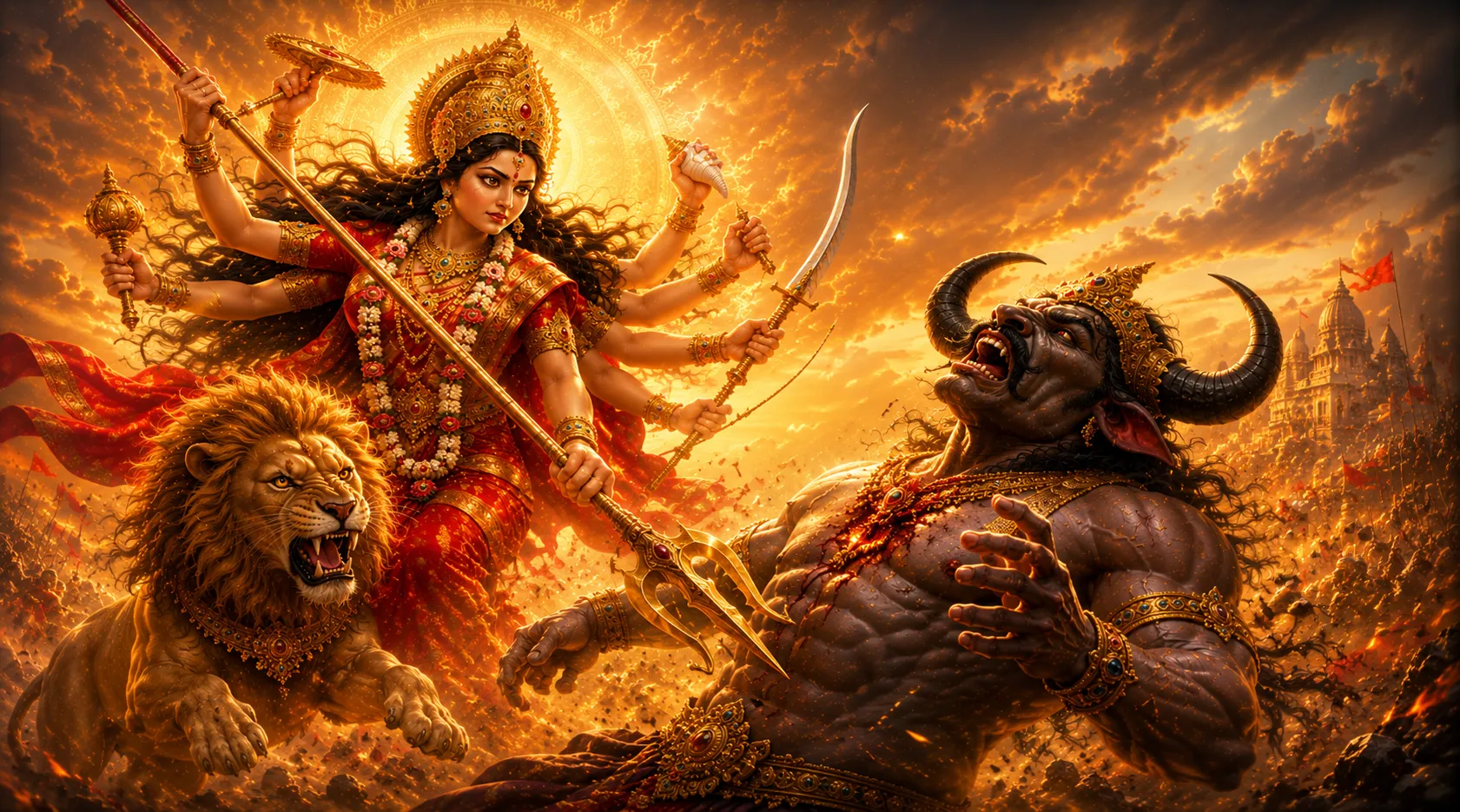
Birth of Durga and Mahishasura
When the demon king Mahishasura terrorizes heaven, earth, and the underworld after receiving a boon that no man can defeat him, the gods combine their divine energies to create Goddess Durga. Armed with celestial weapons from every god, she rides her lion into a nine-day battle against Mahishasura and his army. On the tenth day, Vijayadashami, she defeats the shapeshifting demon, establishing the eternal victory of good over evil that is celebrated as Navaratri and Durga Puja.
Characters
In the age when the world still remembered the ancient wars between the devas and the asuras, there was born a demon unlike any other. His mother was a buffalo demon named Mahishi, and his father was the great asura king Rambha. They named him Mahishasura, meaning the buffalo demon, for even as a child he carried the wild strength of a buffalo in his veins.
From his earliest days, Mahishasura dreamed of power. He watched the devas in their celestial palaces and burned with envy. He wanted what they had. He wanted the throne of Indra. He wanted the nectar of immortality. He wanted the three worlds to bow before him.
But Mahishasura was not just a dreamer. He was cunning. He knew that raw strength alone would never defeat the gods. So he did what many powerful asuras had done before him. He went to the forest. He stood beneath the ancient trees where the air was thick with silence. He folded his hands and closed his eyes. And he began to pray.
His penance was fierce. For a thousand years he stood on one leg, his arms raised to the sky. The sun burned his skin. The rain soaked his matted hair. The wind whipped around his still body. But he did not move. He thought only of Lord Brahma, the creator of the universe. He chanted Brahma's name with every breath. The forest around him fell silent. The birds stopped singing. The animals crept away. The very earth trembled under the intensity of his meditation.
Lord Brahma looked down from his realm and felt the weight of Mahishasura's penance. It pressed against the heavens like a mountain. Brahma knew he had to answer.
The creator god descended in a blaze of golden light. The forest lit up as though a thousand suns had risen at once. The trees sparkled as if touched by starlight. Mahishasura opened his eyes and saw Brahma standing before him, his four faces radiating wisdom and compassion, his eyes holding the secrets of all creation.
Mahishasura bowed low. His voice cracked from a thousand years of silence. He asked for his boon. He wanted immortality. He wanted to never die.
Brahma shook his head. All that is born must die. That is the law of the universe.
Mahishasura thought quickly. If he could not have immortality, he would find another way. He looked at Brahma and made his request. Let no man or god kill me. Let no living being born of a woman defeat me. Let me be invincible in battle.
Brahma studied the demon for a long moment. The boon was clever. It left a loophole, but a small one. No man. No god born of woman. Brahma nodded. He raised his hand and spoke the words of blessing. So be it.
The moment the boon was granted, Mahishasura felt power surge through his body like a river of fire. His veins burned with newfound might. He laughed, and the sound echoed through the forest, through the mountains, through the heavens themselves.
Mahishasura returned to his kingdom and gathered his army. He declared war on the devas. His soldiers marched across the earth, conquering every kingdom in their path. Villages burned. Temples crumbled. The people cried out for help, but no one could stop him.
He stormed the gates of heaven itself. The celestial gardens that had once bloomed with divine flowers were trampled under his hooves. The rivers of milk and honey turned dark. Indra's army fought bravely, but Mahishasura could not be defeated. He threw the devas out of their homes. He took Indra's throne. He crowned himself the emperor of the three worlds.
The gods wandered the earth like homeless beggars. They gathered on the banks of the Ganga, their faces pale with despair. Indra had lost his crown. Agni had lost his fire. Vayu had lost his wind. Surya's chariot stood still in the sky. The moon hid behind the clouds. The world grew dim and cold.
They sat in a circle, their heads bowed, their strength gone. For the first time since the beginning of creation, the devas had no answers. They had lost everything. The demon ruled all.
Lord Brahma looked at them and spoke. There is one way. We cannot defeat him alone. But together, we can create a force that even Mahishasura cannot withstand.
The gods looked up. Hope flickered in their tired eyes. It was a small flame, but it was enough.
Brahma, Vishnu, and Shiva stood together. They closed their eyes and began to concentrate. A light began to glow from their faces. It started as a small spark, then grew brighter and brighter until it was blinding.
From Brahma's face came a light like the dawn of creation, golden and pure, carrying the knowledge of all that was. From Vishnu's face came a light like the sustaining warmth of the sun, steady and eternal, carrying the power of preservation. From Shiva's face came a light like the fire that ends all things, fierce and absolute, carrying the force of transformation. The three lights rose into the sky and merged into one.
The other gods watched in awe. They felt the energy and added their own. Indra gave his strength. Agni gave his heat. Vayu gave his speed. Varuna gave his depth. Kubera gave his wealth. Surya gave his radiance. Chandra gave his coolness. Yama gave his justice. Each god poured something of themselves into that growing sphere of light.
The sphere pulsed like a heart. It hummed with the music of the universe. It turned slowly, gathering power, gathering purpose. It grew larger and larger until it filled the sky. The stars themselves seemed to bow to its glow.
And then, with a sound like a thousand conch shells blowing at once, the light split open.
From the light stepped forth a goddess.
She was more beautiful than the morning star and more terrible than a storm. Her skin glowed like molten gold fresh from the furnace of the sun. Her hair fell in dark waves past her shoulders, each strand shimmering with its own inner light. Her eyes held the wisdom of a thousand ages and the fire of a million suns. When she blinked, it was like the closing and opening of the universe itself.
She had ten arms, each holding a weapon given by the gods. In one hand she held Shiva's trident, the three points crackling with power. In another she held Vishnu's discus, spinning slowly like a wheel of time. She held Indra's thunderbolt, crackling with lightning. Agni's spear burned with eternal flame. Vayu's bow was strung with the wind itself. Varuna's conch carried the sound of the oceans. Kubera's mace was heavy as a mountain. Surya's arrows shone like sunbeams. Yama's noose coiled with the inevitability of fate. And Brahma's kamandalu held the waters of all creation.
Around her neck hung a garland of lotuses that never wilted. On her head rested a crown that shone like the full moon. She wore a saree of red silk that flowed like a river of fire, its edges embroidered with gold thread that told stories of battles yet to come. And at her feet stood a great lion, its golden mane blazing in the light, its muscles rippling with power, its eyes fixed on its mistress with unwavering loyalty.
The goddess opened her mouth and let out a roar that shook the foundations of the universe. The sound rolled across the heavens like thunder. It reached the darkest corners of the earth. It was the sound of hope. It was the sound of war.
The gods fell to their knees. Tears streamed down their faces. They knew who she was. She was Durga. The invincible one. The mother of the universe. The power that had always existed and would always exist, now given form.
A hymn arose from the gods. They sang her praises. They called her by a hundred names. Chandika, the fierce one. Ambika, the mother. Bhadrakali, the auspicious and terrible. Mahamaya, the great illusion. She heard each name and smiled, and her smile was like the first dawn after a long night.
Mahishasura felt the tremor in the heavens. He looked up from his stolen throne and saw a darkness spreading across the sky. No, not darkness. A shadow cast by a light too bright to see. He snarled and called his generals.
Someone has come to challenge me, he said.
His generals laughed. Who would dare?
But their laughter died in their throats when the sky split open and the goddess descended.
Durga rode her lion down from the heavens. The clouds parted before her. The wind carried her hair like a banner of war. The earth shook as the great beast landed, its roar sending tremors through the mountains. The demon army gathered on the plains below, thousands upon thousands of asuras with weapons raised, their battle cries filling the air.
The goddess did not flinch. She did not blink. She raised her trident and charged.
The battle that followed lasted nine days and nine nights. It was a war unlike any the world had ever seen. The sky turned red with the fires of battle. The ground cracked under the weight of armies.
Mahishasura sent wave after wave of his army against her. First came the infantry, a sea of demons rushing forward with swords and spears. Durga drew her bow and rained arrows upon them. Each arrow found its mark. Each shot brought down a dozen demons. Her lion leaped into their ranks, tearing through them like a storm through dry leaves.
Mahishasura watched from his chariot and grew angry. He sent his generals. Chikasura and Chamara led the cavalry, thousands of demons mounted on monstrous beasts. Durga raised Vishnu's discus and hurled it into their midst. The discus cut through them like a scythe through wheat, returning to her hand dripping with demon blood.
Mahishasura himself entered the battlefield. He took his true form, a massive buffalo demon with horns that pierced the clouds. His eyes glowed red like dying embers. His hooves crushed the ground, leaving craters where he stepped. His bellows shook the mountains and sent avalanches tumbling down their slopes.
He charged at Durga. The lion roared and leaped to meet him. Durga swung her mace and struck Mahishasura's side with a force that would have shattered a mountain. He stumbled but did not fall. He turned and charged again, his horns aiming for her heart.
She was faster. She vaulted over his head, landing on his broad back. She drove Shiva's trident into his shoulder. He bellowed in pain and shook her off, his blood steaming where it touched the ground.
Mahishasura changed his form. He became a lion, ferocious and swift. Durga did not retreat. She met him head-on, her lion matching his every move. Then he became an elephant, massive and crushing. Durga dodged his stampeding feet and struck his trunk with her sword. Then he became a giant warrior with a hundred arms, each wielding a different weapon. He attacked from every direction at once.
But Durga matched him every time. She was unshakeable. She was unbreakable. Her ten arms moved like a blur, blocking, striking, countering. She caught his swords with her mace. She dodged his spears. She cut through his arrows mid-flight.
Each night, the gods watched from heaven and held their breath. Would she fall? Would the demon find a weakness? But each morning, Durga rose again, stronger than before. Her lion was tireless. Her weapons never dulled. Her spirit never wavered.
On the ninth night, the demons fought with desperation. They knew the tide was turning. Mahishasura had never faced an opponent like this. His arrogance, which had been his greatest strength, had become his greatest weakness. He could not understand how a goddess could be defeating him. He had a boon. He was invincible. And yet, here she was, driving him back step by step.
He changed into his buffalo form one last time. His eyes were red with rage and exhaustion. Foam dripped from his mouth. He charged at Durga with all the power he could muster, the ground shaking beneath his hooves.
Durga stood her ground. She waited until the last possible moment. Then she leaped. She landed on Mahishasura's back. She pressed her foot down on his neck, pinning him to the earth. The demon struggled. He thrashed. He tried to change his form, but he could not. The goddess's power held him fast.
Mahishasura, she said. You asked that no man could kill you. And no man has. It is the divine mother herself who ends your reign.
She raised Shiva's trident above her head. The three points blazed with the fire of a thousand suns. The universe seemed to pause. Even the wind stopped blowing.
She brought it down.
The trident pierced Mahishasura's chest.
The demon let out a final roar that echoed across the three worlds. It was a sound of rage and disbelief and, finally, acceptance. Then he was still.
For a moment, there was silence.
Then the heavens erupted in celebration. The gods danced. The celestial musicians played. Flowers rained from the sky, covering the battlefield in petals of every color. Apsaras spun through the air. Gandharvas sang victory songs.
Indra bowed before Durga and offered her his throne. She declined with a gentle smile.
I do not need a throne, she said. I am the mother of all. My place is wherever there is suffering, wherever there is injustice, wherever my children need me.
From that day forward, the gods declared that the nine nights of battle would be celebrated as Navaratri, and the tenth day as Vijayadashami, the day of victory. Every year, during the autumn season, when the skies are clear and the air is cool, the faithful would remember the goddess who came to save them. They would build her statues, sing her songs, and tell her story to their children and their children's children.
In Bengal and across India, Durga Puja became the greatest festival of all. Families would gather from far and wide. Children would dress in new clothes, their faces bright with excitement. The sound of dhak drums would fill the air, their beats echoing through the streets. Pandals would rise in every neighborhood, housing beautiful idols of the goddess with her lion and her weapons.
And in every home, the story would be told of how the divine mother defeated the buffalo demon. Of how the powerless found strength in unity. Of how light always finds a way to overcome darkness.
Mahishasura's arrogance had brought him low. He had believed that his clever boon made him invincible. He had thought that by outsmarting the gods, he had secured his victory forever. But he had forgotten one thing. The universe is not ruled by cleverness. It is ruled by dharma. And when dharma is threatened, the divine power rises to protect it.
Durga did not fight for glory. She did not fight for a throne. She did not fight because she hated Mahishasura. She fought because evil had grown too bold and someone had to stand against it. She was the mother who protects her children. She was the warrior who fights for justice. She was the light that dispels darkness.
And so the story of Durga and Mahishasura reminds us that no matter how powerful evil becomes, it can never defeat the divine. The mother is always watching. And when the time comes, she will rise.
✦Moral of the Story
Divine power is greater than any boon when arrogance misuses it
When unity arises among the good, even the mightiest evil cannot stand
True victory belongs to those who fight for dharma, not for domination
Loved This Story?
Read 100+ more sacred Hindu kathas with professional audio narration in both English & हिन्दी on the Tattva app — free, no subscription, no IAP.
Get on Google Play