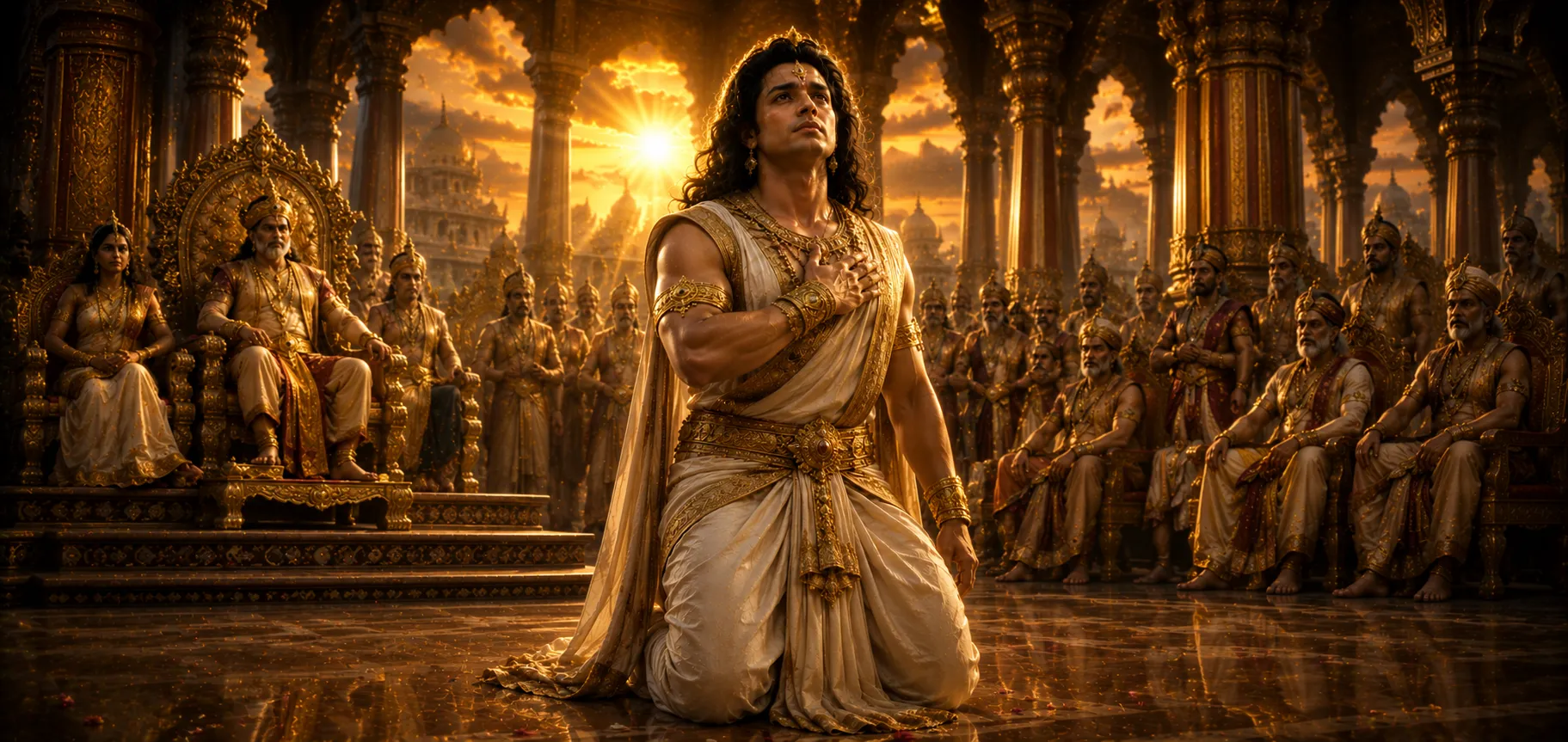
Bhishma's Great Vow
Prince Devavrata, heir to the Kuru throne, makes the ultimate sacrifice when he renounces his claim to the kingdom and takes a vow of lifelong celibacy so that his father King Shantanu can marry the woman he loves. The heavens themselves declare him Bhishma, the one with the terrible oath, and his unwavering commitment to his word becomes the foundation of an epic destiny.
Characters
In the ancient land of Bharata, where the rivers sang hymns and the forests whispered secrets of the gods, the mighty Kuru dynasty ruled from the golden city of Hastinapur. King Shantanu sat upon the throne, and under his reign the kingdom prospered like a garden in eternal spring. The granaries overflowed, the treasury brimmed, and the people slept without fear. Yet for all his glory, a quiet emptiness lingered in the king's heart, a longing he could not name.
One morning, while hunting along the banks of the sacred river Ganga, King Shantanu saw a sight that stole his breath. A woman stood at the water's edge, her beauty so extraordinary that the river itself seemed to pause in its journey to the sea. Her skin glowed like moonlight on still water. Her hair fell in dark waves that caught the golden sun. She walked upon the surface of the river as though it were solid ground, each step leaving ripples that sparkled like scattered diamonds.
Shantanu's heart trembled. He had never seen anyone so radiant, so otherworldly. He approached her with folded hands and asked who she was, whether she was a celestial nymph or the daughter of the gods.
The woman smiled, and the breeze carried the sweet scent of lotus flowers. She said she was Ganga, the river that flows from the heavens to cleanse the earth, the one who washes away the sins of mortals and carries their prayers to the gods.
Shantanu fell to his knees. He begged her to marry him, to become his queen, to grace the throne of Hastinapur with her divine presence.
Ganga looked at the king with eyes as old as time and agreed to marry him, but on one condition. Shantanu must never question her actions, no matter what she did. He must never speak a word of anger or doubt toward her. The day he broke this promise, she would leave him forever.
Shantanu agreed without hesitation. His love for her was too great to imagine any act of hers that could disturb his peace.
They were married in a ceremony that dazzled the heavens. Ganga came to Hastinapur, and the kingdom rejoiced. The queen was kind, gracious, and devoted to the king. Weeks passed in bliss, and Shantanu believed he was the happiest man in all the three worlds.
Then Ganga gave birth to their first son. The palace erupted in celebration. But that night, as the moon hung low and silent, Ganga took the newborn baby to the river. Without a word, she walked into the waters. The baby slipped from her arms and sank beneath the surface. The river swallowed him whole.
Shantanu watched from the shore, frozen in horror. His heart shattered into a thousand pieces. But he remembered his promise. He clenched his fists until his nails dug into his palms. He said nothing.
She returned to the palace as though nothing had happened. The servants asked no questions. The king retreated to his chambers and wept alone.
The same thing happened again and again. Seven times, Ganga gave birth. Seven times, she took the child to the river. Seven times, the waters claimed the infant. Each time, Shantanu's pain grew deeper. Each time, he bit his tongue until it bled. Each time, he held his silence, though his soul screamed.
When the eighth son was born, something inside Shantanu snapped. As Ganga turned toward the river with the baby in her arms, Shantanu rushed forward and blocked her path. He cried out for her to stop, begging her not to harm this child. He said he could not lose another son and demanded to know who she truly was and why she was doing this.
Ganga stopped. She turned to face her husband, and her eyes held no anger. Only a deep, ancient sorrow.
She reminded him that he had broken his promise and told him she must now leave. But before she went, she revealed the truth. The seven children she had drowned were the Vasus, celestial beings who had been cursed by the sage Vashishtha to be born on earth. By drowning them, she had freed them from the curse, releasing their souls to return to heaven. The eighth child, too, was a Vasu, but he was destined for something greater.
Ganga told Shantanu that this child would be extraordinary. He would be a warrior without equal, a sage among kings, a soul whose name would echo through the ages. She said he would be known for his wisdom, his strength, and his sacrifice. She asked Shantanu to raise him well and then pressed the baby into the king's trembling arms.
She stepped into the river. The waters closed around her like a silk veil, and she was gone.
Shantanu stood on the bank for a long time, holding his son, tears streaming down his weathered face. He named the child Devavrata, meaning one who is devoted to the gods.
Devavrata grew, and Ganga had not abandoned him completely. She appeared to the king in a dream and told him she would train the boy herself. She took Devavrata to the celestial realms and placed him under the greatest teachers in the universe. The god of war taught him archery and the use of every weapon known to the devas and asuras. The sage Brihaspati taught him statecraft, law, and the art of ruling with wisdom. The rishis taught him the Vedas, the Upanishads, and the deepest truths of dharma.
Years passed. When Devavrata returned to Hastinapur, he was everything a prince should be and more. Tall and broad-shouldered, with eyes that held the calm of deep oceans and the fire of a warrior's spirit. He was kind to the weak, humble before the wise, and fierce in the protection of the innocent. The people saw him and felt hope. The soldiers saw him and felt pride. The sages saw him and felt peace.
Shantanu was overjoyed beyond words. He declared Devavrata the crown prince of Hastinapur, and the entire kingdom celebrated. The future of the Kuru dynasty blazed brighter than ever.
Years passed peacefully. Hastinapur grew in wealth and glory.
Then one afternoon, while riding along the banks of the Yamuna, King Shantanu encountered a mystery. A fragrance drifted across his path, so sweet and intoxicating that it seemed to pierce his very soul. It was unlike anything he had ever smelled. The scent of a thousand flowers blended with the freshness of monsoon rain, warm earth, and something else, something wild and pure.
He followed the fragrance through a grove of kadamba trees until he reached a small wooden dock. There, sitting in a simple boat woven from bamboo and reeds, was a young woman. Her beauty was not the cold radiance of the stars. It was warm and earthy, like the forest after rain, like fresh honey, like the first ray of dawn touching a lotus pond. Her skin had the warmth of amber. Her eyes were deep and dark and knowing.
Shantanu's heart stirred in a way it had not stirred since the days of Ganga.
He approached her and asked her name. She smiled and said she was Satyavati, the daughter of the fisherman chief Dasaraj. She ferried people across the Yamuna in her boat. She asked if he needed passage.
Shantanu did not need passage. But he climbed into her boat anyway. She rowed him across the river, and in those few moments, the king of Hastinapur fell deeply, hopelessly in love.
He returned the next day. And the next. And the next. He watched her mend her nets. He listened to her sing soft songs as she rowed. He brought her gifts of flowers and silk, but she accepted them with a shy humility that only made him love her more.
Finally, Shantanu could bear it no longer. He rode to the hut of Dasaraj, the fisherman chief, and asked for Satyavati's hand in marriage.
Dasaraj was stunned. A king, marrying a fisherman's daughter. It was an honour beyond anything his family had ever known. He should have agreed at once. But Dasaraj was a father first, and a fisherman second. He thought of his daughter's future. He thought of the children she would bear.
He spoke with slow, careful words. Great king, he said, I would be the happiest man in the world to give you my daughter. But I am an old man, and I must think of what comes after me. Your son Devavrata is the crown prince. He is young, strong, and beloved by all. When Satyavati bears you sons, what will become of them? Will they be pushed aside? Will they live in Devavrata's shadow forever?
Shantanu's face fell. The words struck him like arrows. He opened his mouth to speak, but no words came.
Dasaraj continued. If you promise me that Satyavati's son will sit on the throne of Hastinapur, I will give you her hand. But only then.
Shantanu could not answer. He could not ask Devavrata to give up the throne. It was not fair. It was not right. It would break his son's heart. Without a word, the king turned and walked away, his shoulders heavy with sorrow.
Back in the palace, Shantanu grew pale and quiet. He stopped attending court. He stopped eating. He wandered the marble corridors like a ghost, staring at nothing, speaking to no one. The ministers whispered. The queen worried. The kingdom began to tremble.
Devavrata noticed. He had returned from a hunting expedition to find his father a shadow of the man he once was. He went to the chief minister, an old man who had served the throne for forty years, and asked what troubled the king.
The minister hesitated. Then, with a heavy heart, he told Devavrata everything. About the fisherman's daughter. About the condition. About the king's silent agony.
Devavrata listened in perfect stillness. His face betrayed no emotion, but inside, a storm was brewing. He loved his father more than the throne. More than his own future. More than anything.
He knew what he had to do.
The next morning, Devavrata rode alone to the fisherman's village. He found Dasaraj sitting by the river, mending a fishing net with calloused hands. The old man looked up and saw the prince. He set down his net and stood.
Devavrata spoke calmly. He said he had come to ask for Satyavati's hand on behalf of his father. He said he understood Dasaraj's condition and accepted it fully. He renounced his claim to the throne of Hastinapur. Satyavati's son would be the king.
Dasaraj's eyes widened. He had not expected this. Here was a young prince, the future of a dynasty, calmly giving up everything. But Dasaraj was a cautious man, and his mind turned to the future.
He spoke again. Young prince, he said, I see your nobility. But what of your children? Someday you will marry. You will have sons. They may not share your generosity. They may look at the throne and feel that it belongs to them. They may challenge Satyavati's children. What guarantee do I have?
Devavrata's jaw tightened. He had not anticipated this question. But he understood the fisherman's fear. And he knew what the answer required.
He took a deep breath. The river murmured beside them. A bird called somewhere in the trees. The wind carried the scent of earth and water. And in that moment, Devavrata made a choice that would define him for all eternity.
He spoke, and his voice was steady as stone. He made a vow before Dasaraj, before the gods, before the earth and the sky and every living creature. He renounced his claim to the throne of Hastinapur forever. And he vowed to remain celibate for the rest of his life. He would never marry. He would never father a child. No son of his would ever rise to challenge Satyavati's children. This was his oath. This was his promise. He would carry it to his dying breath.
Dasaraj stared, his mouth hanging open. The net slipped from his fingers.
Then the sky answered.
Thunder rolled across the heavens, deep and rumbling, shaking the very ground beneath their feet. The clouds parted, and a shower of celestial flowers rained down upon the riverbank, each petal glowing with divine light. The air filled with the sound of heavenly drums. And a voice, vast and ancient, echoed from the celestial realms, so loud that it echoed across the fourteen worlds.
Bhishma. Bhishma. He shall be called Bhishma, for his vow is terrible. He shall be known by this name for all eternity.
Dasaraj fell to his knees. The village elders who had gathered bowed their heads to the ground. The birds in the trees fell silent. Even the river seemed to hold its breath.
Devavrata stood alone in the rain of celestial flowers, transformed. He was no longer just a prince. He was Bhishma, the one with the terrible oath.
Word reached Hastinapur before Bhishma returned. King Shantanu was waiting at the gates of the palace, his eyes red with weeping. When Bhishma entered, Shantanu rushed forward and wrapped his arms around his son, holding him as though he would never let go.
Through his tears, Shantanu told his son that he had given him everything. His future. His lineage. His happiness. No father in all the history of the world had ever had a son like him. He said he could not give back the throne. He could not give him a wife or children. But he could give him one gift.
Shantanu raised his hand and placed it on Bhishma's head. He granted Bhishma a boon that no mortal had ever received. He gave him the power to choose the moment of his own death. Death would never approach Bhishma unless Bhishma willed it. He would live as long as he wished, and leave this world only when he chose.
Bhishma bowed his head and accepted the boon, not as a reward, but as a tool to serve the dynasty he loved.
Shantanu married Satyavati in a grand ceremony. The fisherman chief blessed the union with tears of joy. Satyavati came to Hastinapur as queen. In time, she bore two sons, Chitrangada and Vichitravirya.
And Bhishma, true to his vow, served them all. He protected the young princes with his life. He taught them the arts of war and the wisdom of statecraft. He stood guard over the Kuru dynasty like a mountain that could never be moved. He never once looked back at the throne he had given up. He never once regretted the children he would never hold.
He lived by his word. His vow was his very breath. He became the greatest warrior of his age, the wisest counsellor, the most trusted guardian. Kings from faraway lands came to seek his advice. Sages sought his wisdom. Enemies trembled at the sound of his name.
But beneath the armour and the glory, there was always the memory of that day by the river. The moment when a young prince became something more than a prince. The moment when the heavens wept flowers and declared his name.
Bhishma. The one with the terrible oath. The one who gave up everything for love, and in doing so, earned the love of the gods themselves.
✦Moral of the Story
True sacrifice means giving up something precious not for personal gain, but for the happiness of someone you love
A vow once made must be honoured with unwavering resolve, no matter how difficult the path becomes
The greatest strength lies not in holding power, but in having the courage to let it go for a higher purpose
Loved This Story?
Read 100+ more sacred Hindu kathas with professional audio narration in both English & हिन्दी on the Tattva app — free, no subscription, no IAP.
Get on Google Play