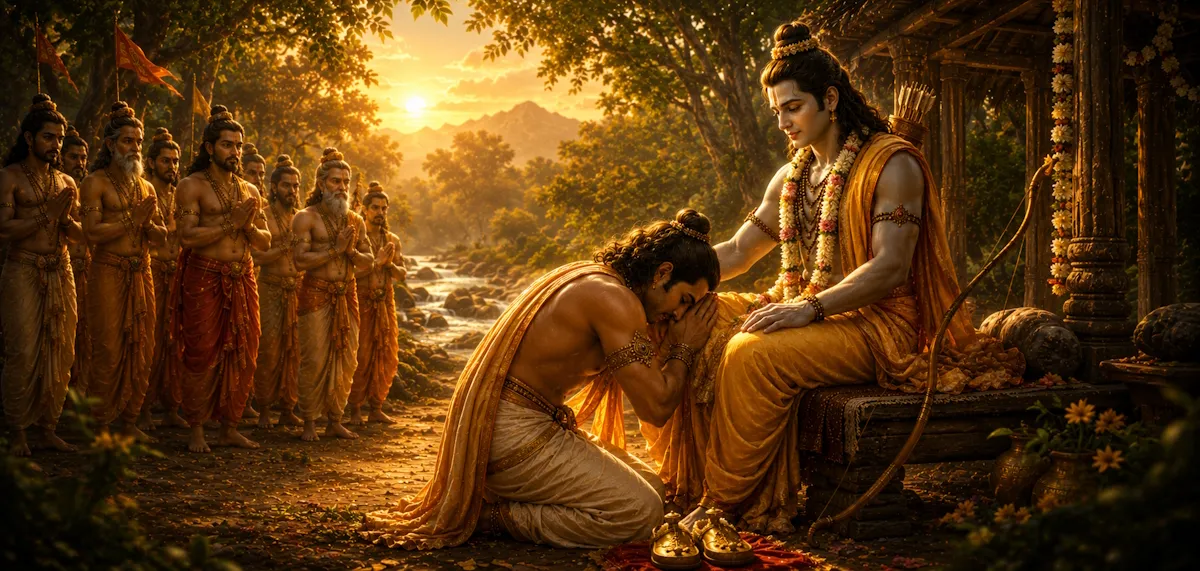
Bharata Meets Rama
When Bharata returns from his uncle's palace, he discovers his father has died and Rama has been exiled because of his mother Kaikeyi's demands. Furious and heartbroken, Bharata refuses the throne and travels to the Chitrakoot forest to bring Rama back. Rama explains he must honor their father's word, so Bharata receives Rama's wooden paduka and places them on the throne, ruling Ayodhya as a humble caretaker from Nandigram for fourteen years.
Characters
The road to Ayodhya had never seemed so long. Prince Bharata sat in his chariot, watching the familiar countryside roll by, unaware that the world he was returning to had already crumbled. He had spent many happy months at his uncle's palace in the kingdom of Kekaya, surrounded by cousins and laughter. Now he was coming home, eager to see his father King Dasharatha, eager to embrace his brothers, and most of all, eager to see Rama.
Beside him rode his younger brother Shatrughna, equally cheerful. They talked about the welcome feast their father must have prepared. They joked about how Lakshmana would tease them for being late. They wondered if Rama had finally accepted the crown that everyone in Ayodhya wanted him to wear. The sun was warm, the breeze was gentle, and the world felt full of promise.
But as their chariot approached the city gates, Bharata noticed something strange. The massive gates stood open, but no crowds gathered to welcome them. No flower petals fell from the balconies. No children ran alongside the chariot shouting their names. The streets of Ayodhya lay silent, wrapped in a heavy and suffocating quiet. The shops were closed. The windows were shuttered. The city looked like a painting drained of all color.
Bharata's smile slowly faded. He looked at Shatrughna and saw his own unease reflected in his brother's eyes. Something was terribly wrong.
The chariot rolled into the palace courtyard. Bharata leaped down before the horses had fully stopped. The guards bowed low without meeting his eyes. Servants hurried past with their heads down. Even the palace deer, usually so playful, stood still and watchful. The palace itself seemed to be holding its breath, waiting for something that had already happened.
Bharata ran through the corridors, his heart pounding. The first person he found was his mother, Queen Kaikeyi. She stood in her chambers, dressed in plain white clothes, her face unreadable. A small, satisfied smile played at the corner of her lips, a smile that Bharata would remember for the rest of his life.
Mother, Bharata said, breathless. What has happened? The city is like a graveyard. Where is everyone? Where is Father? Where is Rama?
Kaikeyi reached out to touch his face. My son, she said softly. You are the king of Ayodhya now.
Bharata staggered backward as if she had struck him. His blood ran cold. What are you saying? Where is Father? Where is Rama? His voice rose with each question.
Your father is no more, Kaikeyi said, her voice flat and without emotion. He died of a broken heart. And Rama is in the forest. I asked for your coronation and his exile. I used the two boons your father gave me long ago. And I got both.
The words hit Bharata like stones. His father was dead. Rama was exiled. And his mother, his own mother, was the cause of it all. He felt the world tilt around him. His hands trembled. His breath became ragged. He looked at his mother and for the first time in his life, he felt no love for her. Only a cold and burning rage.
What have you done? he whispered. His voice cracked. You have destroyed this family. You have killed my father. You have stolen my brother from me. And you did it all in my name. In my name, Mother. Do you understand what you have done to me?
Kaikeyi tried to speak, but Bharata turned away. He could not bear to look at her face. He rushed out of her chambers and through the long corridors until he reached Queen Kaushalya's rooms. He found the elder queen sitting on the floor, her head bowed, her eyes swollen from days of weeping.
Bharata fell at her feet and touched her knees. Mother Kaushalya, he cried. Tell me everything. Please. I need to know.
Kaushalya placed her trembling hand on his head. In a broken voice, she told him everything. The two boons that Kaikeyi had saved for years. Manthara's poisonous whispers that had turned the queen's heart. The night of the planned coronation that became a night of exile. His father's desperate pleas to Kaikeyi. The king's final cries for Rama as his heart shattered. And Rama's gentle acceptance, his refusal to fight, his silent departure into the forest with Sita and Lakshmana, walking barefoot into the unknown.
Bharata listened with tears streaming down his face. When she finished, he pressed his forehead to the floor. I had no part in this, he sobbed. I swear by every god, I did not know. I would have died before taking what belongs to Rama. I would have given my own life.
Kaushalya placed her hand on his head. I know, my child. I know you are innocent. But the damage is done. Your brother is gone. My son is gone.
That night, Bharata did not sleep. He sat alone in the darkness, his mind racing like a river in flood. The citizens of Ayodhya were grieving. His brothers were gone. His father was dead. And the throne, that cursed throne, waited for him like a trap. He thought of Rama walking through the dark forests, sleeping on the hard ground, eating roots and berries. He thought of Sita, a princess of Mithila, enduring the hardships of the wilderness. And he thought of his mother's face, that satisfied smile, and his stomach turned.
At dawn, Bharata summoned the royal ministers and the great sage Vasishta. He stood before them in the council hall, his eyes red from weeping but his voice steady as stone. He had made his decision in the darkest hour of the night, and nothing would change it.
I will not sit on that throne, he declared. His words echoed through the hall. It belongs to Rama and only Rama. I am going to the forest to bring him back. If he refuses to return, I will not rule. I will live in Nandigram as a hermit until my brother comes home.
The ministers tried to convince him otherwise. They spoke of duty and responsibility. They said the kingdom needed a king. But Bharata would not listen. Within hours, he had gathered a small army of trusted companions. He invited the three queens to join him. He requested Guru Vasishta to accompany them. Together with Shatrughna and a group of loyal elders, he set out for the Chitrakoot forest.
The journey was long and difficult. The roads grew rough as they left the kingdoms and entered the wild forests of central India. The path narrowed until their chariots could go no further. Bharata walked on foot. The forest was thick and untamed. Strange birds called from the treetops. Monkeys watched them from the branches. The air smelled of damp earth and flowering vines.
At the banks of the mighty Ganga, they met King Guha of the Nishadas. Guha had helped Rama cross the river many days ago and remembered the gentle prince with great fondness. He told Bharata exactly where Rama was staying, on the slopes of Chitrakoot near the banks of the Mandakini River. Guha offered his boats and his blessings.
Bharata thanked him and crossed the river with his companions. The forest grew even denser on the other side. The sounds of birds and animals surrounded them. Vines hung from ancient trees. Patches of sunlight fell through the canopy like golden coins. And then, after days of traveling through this wild beauty, they saw it in the distance. A small clearing. A simple ashram built among the trees near the base of a gentle hill. Smoke rose from a cooking fire. A small garden of greens grew beside a tiny stream.
Rama's ashram.
Bharata's heart hammered in his chest. He asked everyone to wait and walked forward alone. His legs felt weak. His throat was dry. His eyes blurred with tears. He could barely see the path in front of him.
And then he saw Rama.
His brother sat cross-legged on a simple mat of grass outside a small hut made of leaves and bamboo. The royal clothes were gone, replaced by bark garments tied at the waist. His hair was matted and unkempt. His body was thinner, leaner from days of fasting and walking. But his face, that beloved face, held the same gentle smile that Bharata had carried in his heart every day of his exile. There was no anger in that face. No bitterness. Only peace and welcome.
Beside Rama sat Sita, her head covered with a simple cloth, her eyes downcast but warm. Lakshmana stood nearby, his hand resting on his bow, watching the visitor approach with a guarded expression.
Bharata could not speak. He ran forward, his legs giving way beneath him, and fell at Rama's feet. He clutched his brother's ankles and sobbed. Great, heaving cries tore through his body. He could not lift his head. He could not say a single word. He pressed his forehead again and again to Rama's feet, begging without words for forgiveness.
Rama reached down and gently lifted him up. Bharata, he said softly. His voice was like a balm on an open wound. My brother. Do not weep.
But Bharata could not stop. He pressed his head to Rama's chest and wept like a child. I am sorry, he cried. I am so sorry. I did not know what my mother was planning. If I had been here, I would have stopped it. I would have given my own life before letting this happen to you. To Sita. To our father.
Rama pulled him close and held him. You have nothing to be sorry for, Bharata. You are not responsible for the actions of another. This is my dharma. This is our father's wish. I must honor it. And you must honor it too.
But Ayodhya needs you, Bharata pleaded, pulling back to look at his brother's face. The people are crying for you. Our mothers are broken. Our father died calling your name. Please, Rama. Come back. The kingdom is yours. The throne is waiting.
Rama shook his head gently. His eyes were kind but his voice was firm. I cannot, Bharata. A promise made by our father is a promise I must keep. Fourteen years in the forest is what was asked and fourteen years in the forest is what I will give. Dharma is not a path we choose only when it is easy. It is the path we walk even when it breaks our heart. If I return now, what kind of lesson would that be? That a king's word means nothing? That promises can be broken when they become inconvenient?
They sat together under the shade of a large tree. Sita served them a simple meal of forest fruits and roasted roots. Lakshmana sat nearby, his eyes softening as he watched the two brothers talk. Bharata told Rama about their father's last days. He described the king's final moments, how he had called out for Rama until his last breath. Rama listened in silence, his eyes filling with tears that he did not try to hide. They flowed down his cheeks and fell onto the forest floor.
They talked for hours as the sun moved across the sky. Bharata argued, begged, and reasoned. He tried every argument he could think of. He spoke of the people's love, the kingdom's need, the mothers' grief. But Rama remained unmoved. His resolve was as strong as the Vindhya mountains that surrounded them. No plea, no argument, no display of grief could change his mind.
Finally, as the evening shadows grew long, Bharata understood. His shoulders sagged in defeat. But then a thought came to him, a way to take something of Rama back to Ayodhya, a way to keep his brother present even in his absence.
Give me something to take back, he said softly. His voice was hoarse from weeping. Something that belongs to you. Let me place it on the throne so that the people can feel your presence. Let me rule not as a king but as your servant until you return. Let me be your shadow, Rama. Nothing more.
Rama smiled. It was a sad smile, but it was full of love. He reached down and took off his wooden sandals, the simple paduka that had walked the rough forest paths, crossed streams, and climbed the hills of Chitrakoot. He held them out to Bharata.
These are yours now, Rama said. Place them on the throne. Let them be a symbol that I am still with you. Rule Ayodhya with wisdom and compassion. Protect the people. Uphold dharma. And when fourteen years have passed, I will come home. I promise you.
Bharata received the sandals with trembling hands. He pressed them to his eyes. He pressed them to his heart. Then he placed them reverently on his head, as if they were Rama himself. He would carry them back to Ayodhya with more care than he would carry a crown of gold.
They embraced one last time. Bharata held his brother for a long moment, memorizing the feel of his shoulders, the smell of his skin, the sound of his breathing. Rama blessed him. Lakshmana bowed his head. Sita smiled through her tears and touched Bharata's hand in blessing.
And Bharata walked away, the wooden sandals clutched against his chest, a new fire burning in his heart. He did not look back. He could not. He knew that if he looked back, he would fall at Rama's feet again and never find the strength to leave.
Back in Ayodhya, Bharata did not enter the palace. He went straight to Nandigram, a small village outside the city walls. There, in a simple ceremony, he placed Rama's sandals on the royal throne. He performed a full coronation for the sandals, complete with rituals and offerings. The priests chanted. The people watched in awe. And the sandals sat upon the throne, silent and unmoving, yet carrying the weight of a kingdom.
Bharata himself never sat on the throne. He never wore royal robes. He never called himself king. He signed every order as a servant of Rama. He slept on the floor of a small hut in Nandigram, dressed in the bark garments of a hermit, eating simple food once a day.
For fourteen years, Bharata lived like this. He ruled Ayodhya with wisdom and fairness, but always as a caretaker, never as a master. Whenever a difficult decision had to be made, he would go to the throne room, look at the sandals, and ask himself a simple question. What would Rama do? And the answer would come to him, clear as a bell in the silence of the night.
The people of Ayodhya watched their prince with wonder and love. Here was a man who had been offered an empire and had refused it. Here was a brother whose love was so pure that he chose to live as a beggar rather than sit on his brother's throne. In every home, in every temple, the story was told. Bharata, the prince who ruled with sandals. Bharata, the king who never wore a crown.
And deep in the forest of Chitrakoot, Rama heard reports of his brother's devotion. He smiled and looked up at the sky through the leaves of the trees. That is my brother, he whispered. That is Bharata. There is no one in the world like him.
The story of Bharata's love for Rama is not a story of war or adventure. It is not a tale of monsters slain or kingdoms conquered. It is the story of a heart so pure that it chose pain over power, humility over pride, and devotion over everything the world could offer. It teaches us that true love does not seek to possess. It seeks to honor. It serves. It waits. It bows.
And sometimes, the greatest kings are not the ones who sit on the throne, but the ones who place another's sandals upon it and step away with a smile.
✦Moral of the Story
True love does not seek power but serves the one it loves with humility and devotion
Dharma must be honored even when it demands the greatest personal sacrifice
A leader's greatest strength is not authority but the willingness to bow before righteousness
Loved This Story?
Read 100+ more sacred Hindu kathas with professional audio narration in both English & हिन्दी on the Tattva app — free, no subscription, no IAP.
Get on Google Play