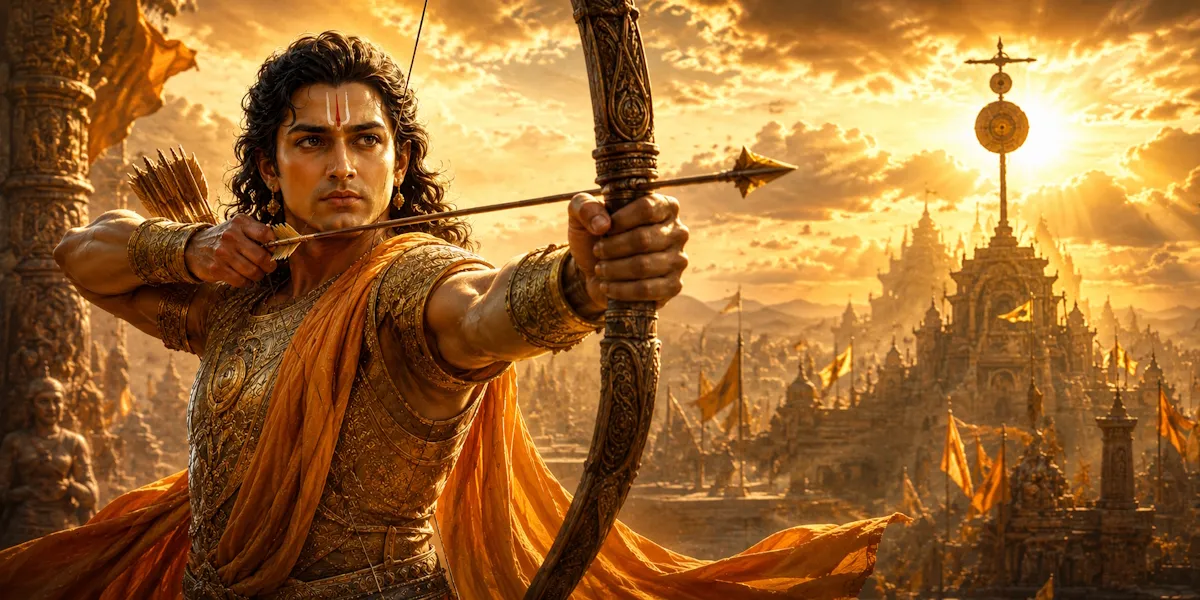
Arjuna's Focus
At the Gurukul, Guru Dronacharya tests the Kuru princes with a simple wooden bird perched high in a tree. One by one, the princes fail because they see the tree, the leaves, the sky, and everything around the target. Only Arjuna, through his extraordinary focus, sees nothing but the bird's eye and proves why he is destined to become the greatest archer in the world.
Characters
The morning sun painted the sky in soft shades of gold and rose as the students of the Gurukul gathered in the training ground. A gentle breeze carried the scent of wet earth and blooming jasmine across the open field. Dew still clung to the tips of the grass blades, shimmering like tiny diamonds in the early light. The ancient banyan trees that surrounded the clearing stood tall and silent, their long branches swaying slowly in the morning air. Birds chirped from their nests, and the distant sound of river water flowing over stones could be heard from beyond the tree line.
It was a beautiful morning, peaceful and full of promise. But there was no time to admire the beauty of dawn. Today was not an ordinary day at the Gurukul.
Guru Dronacharya had announced a special test, one that would separate the merely skilled from the truly exceptional. For weeks, the princes had whispered among themselves about what the test might involve. Some thought it would be a battle simulation. Others believed it would test their knowledge of the scriptures. But no one knew for certain. And Dronacharya had kept the details a closely guarded secret.
The training ground of the Kuru princes stretched wide before them. It was a vast open space of packed earth, surrounded by towering neem and peepal trees. Wooden targets stood at various distances, each marked with painted red circles at the center. Straw dummies shaped like warriors lined the far end, their painted faces staring blankly ahead. Dozens of quivers, each filled with arrows fletched with eagle and peacock feathers, stood beside every shooting post. Bows of different sizes and weights rested on wooden racks, waiting for the hands of their owners.
Everything was ready.
The princes had trained under Dronacharya for years. They had learned to stand, to breathe, to hold, and to release. They could hit any target with speed and precision. They could fire while riding a horse, while running, while standing on one foot. But Dronacharya knew something that the princes did not. He knew that hitting a stationary target and achieving true mastery were two completely different things.
Among the students stood the Pandavas and the Kauravas, a hundred young princes of the Kuru dynasty. Yudhishthira stood tall and calm at the front, his posture perfect but his eyes slightly unfocused, his mind already wandering through questions of duty and righteousness. Next to him, Bhima fidgeted with his bow, rolling it in his massive hands, his strength unmatched but his patience dangerously thin. He cracked his knuckles and shifted his weight from one foot to the other, eager for action.
Duryodhana stood apart from the others, his arms crossed, his jaw tight. His eyes burned with ambition. He was always watching, always comparing, always measuring himself against everyone else. He had to be first. He had to be the best. Anything less was unacceptable.
Nakula and Sahadeva stood together, whispering about the birds in the trees. Nakula noticed the way the morning light fell through the leaves, casting dappled shadows on the ground. Sahadeva pointed at a squirrel running along a branch. They were good boys, kind and intelligent, but their minds fluttered like butterflies from one thing to the next.
Ashwatthama, Dronacharya's own son, stood near his father. He was naturally gifted, perhaps the most talented archer among the princes in terms of raw skill. He could hit targets that others could not even see clearly. But he relied too much on his talent and too little on discipline.
And then there was Arjuna.
Arjuna was the third Pandava prince. From the moment he had first held a bow at the age of seven, something deep within him had awakened. It was as if he had been born for this purpose and had only now discovered it. While other boys played, Arjuna practiced. While others rested, Arjuna aimed. While others slept, Arjuna dreamed of the perfect shot.
His dedication was unlike anything Dronacharya had ever seen in a student. There was a story that the other princes often told in whispers. When Arjuna had first come to Dronacharya, the guru had given him a clay doll and told him to practice aiming at it. Days passed, then weeks, then months. The other princes grew bored with their own dolls and moved on to bigger challenges. But Arjuna stayed with his clay doll, day after day, practicing the same motion thousands of times until it became as natural as breathing.
One evening, Dronacharya had asked him why he did not ask for a more interesting target. Arjuna had simply replied that the target was not important. What mattered was the archer. If the archer was not perfect, even the most interesting target was meaningless. Dronacharya had said nothing, but he had smiled to himself. He knew then that this boy was special.
Now, years later, Arjuna stood quietly among the princes. Dark-skinned and handsome, with eyes that seemed to look right through any object they focused on, he was calm and utterly still. He did not fidget. He did not whisper. He did not look around. He stood with his bow in his hand, his gaze fixed on some invisible point in the distance, already preparing himself for whatever was to come. His breathing was slow and rhythmic. His heart beat with the steady patience of a hunter waiting for dawn.
Dronacharya walked to the center of the field. In his right hand, he held a small wooden bird. It was beautifully carved, with delicate wings spread as if in mid-flight, a sharp beak, and tiny carved feathers along its body. The bird was painted in soft browns and whites, and its eye was a single black dot of polished wood.
He placed the bird high on a branch of the tallest neem tree, nearly forty feet above the ground. The branch swayed slightly in the breeze, and the bird rocked gently with it.
The princes watched curiously. Some exchanged puzzled glances.
Dronacharya turned to face them. His voice, deep and calm, carried across the entire field without effort. He announced that the wooden bird would be their target for the day. Each prince would take his bow, stand at the marked line, nock an arrow, and prepare to shoot. But before releasing the arrow, Dronacharya would ask a question. And they must answer truthfully.
The princes murmured among themselves. A wooden bird on a high branch. It seemed far too simple. They had shot moving targets before. They had pierced ripe mangoes hanging from ropes while they swung in the wind. They had struck coins tossed into the air. What could possibly be difficult about a still wooden bird perched on a branch?
Duryodhana smirked. He was certain this would be his moment to shine.
One by one, Dronacharya called the princes forward.
Yudhishthira stepped up first. He walked with the quiet dignity of a future king. He selected his bow, tested the tension of the string, and took his position at the marked line. He raised his bow, pulled the string taut against his cheek, and narrowed his eyes at the bird. But just as his fingers began to relax for the release, Dronacharya placed a gentle hand on his shoulder.
Dronacharya asked Yudhishthira what he saw.
Yudhishthira paused. He lowered his bow slightly and considered the question carefully. He replied that he saw the bird, of course, but he also saw the sturdy neem tree on which it sat, the way the leaves swayed gently in the morning breeze, the patches of blue sky visible through the gaps between the branches, and the golden sunlight filtering through the canopy.
Dronacharya shook his head slowly. He told Yudhishthira that he saw too much. He asked him to step aside.
Yudhishthira bowed, his brow furrowed in confusion. He obeyed without argument, but as he walked away, he kept repeating the question in his mind. What did he mean, too much?
Next came Duryodhana. He strode forward with confident, heavy steps, his chest puffed out, a smug smile on his lips. He picked the largest bow, strung it with a sharp pull, and nocked an arrow with practiced speed. He took his position, raised the bow, and pulled the string back with the ease of long practice.
Dronacharya asked him what he saw.
Duryodhana replied without hesitation, his voice impatient. He said he saw the bird clearly. He also saw the tree trunk, broad and brown below it. He could see his brothers standing behind him, the other targets scattered across the field, and a kite circling high in the sky. He declared that he could see everything, because a true warrior had to be aware of his surroundings.
Dronacharya sighed deeply. He told Duryodhana that he saw everything and therefore saw nothing of importance. He asked him to step aside.
Duryodhana's face reddened with anger. His hands tightened on his bow until his knuckles turned white. He wanted to argue. He wanted to demand an explanation. But something in Dronacharya's calm gaze stopped him. He lowered his bow, turned sharply, and stalked back to his place, muttering under his breath.
One by one, the princes came forward.
Bhima stepped up, his massive frame casting a long shadow. He aimed quickly, barely taking time to focus. Dronacharya asked what he saw. Bhima answered that he saw the bird and the thick branches around it, which he could probably break with his bare hands if he wanted to. Dronacharya sent him back.
Nakula came forward. His aim was graceful, almost like a dance. He saw the bird and the beautiful flowers blooming on a nearby creeper. He noticed how the morning light made the bird's wooden feathers glow. Dronacharya sent him back.
Sahadeva stepped up. He was knowledgeable, perhaps the wisest of the younger princes. He saw the bird, but he also noticed that a cloud was passing overhead, casting a shadow across the field. He thought the changing light might affect the shot. Dronacharya sent him back.
Ashwatthama came forward confidently. He was Dronacharya's own son, and the other princes expected him to succeed where they had failed. He took aim with perfect form. Dronacharya asked what he saw. Ashwatthama replied that he saw the bird's feathers, the curve of its wings, the sharpness of its beak, and the tiny legs gripping the branch. He described every detail with impressive accuracy. But Dronacharya shook his head and sent him back too.
With each failure, the tension in the field grew thicker. The sun climbed higher, and the morning coolness gave way to a gentle warmth. The birds had stopped chirping, as if they too were watching the test. The younger princes shifted nervously. Duryodhana paced like a caged animal. Yudhishthira stood in deep thought, still trying to understand what he had done wrong.
But Dronacharya remained patient. Calm. Unhurried. He was waiting for one student. Only one.
Finally, he called Arjuna's name.
The field fell silent.
Arjuna stepped forward. Unlike the others, his face showed no anxiety, no impatience, no pride. His expression was peaceful, like the surface of a lake untouched by wind. His eyes were clear and steady, focused on something that no one else could see.
He walked to the weapon rack and picked up his bow. It was the Gandiva, the magnificent bow that he had earned through years of devotion and relentless practice. The bow seemed to hum in his hands, as if it recognized its true master. He tested the string once, the sound a low, resonant thrum that echoed across the field.
He nocked an arrow with slow, deliberate care. Every movement was precise, economical, perfect. He raised the bow. He pulled the string back. His posture was a study in elegance, his left arm straight and firm, his right elbow high, his fingers resting lightly on the string. His breathing became so shallow and steady that he seemed to have stopped breathing altogether.
His entire being had narrowed into a single point of focused energy. He was no longer a man standing in a field. He was an arrow, an extension of the bow itself, aimed at a target that only he could truly see.
Dronacharya approached him and asked softly what he saw.
Arjuna replied in a voice so calm that it seemed to come from far away. He said that he saw the bird.
Dronacharya pressed further. He asked if Arjuna could see the tree. The leaves. The sky. The other princes.
Arjuna replied without moving, without wavering. He said no. He saw only the bird.
Dronacharya leaned closer. He asked what part of the bird Arjuna could see.
Arjuna answered that he saw its eye.
Dronacharya asked if he could see the beak. The wings. The feet. The polished wooden feathers.
Arjuna answered that he saw only the eye.
Dronacharya's voice dropped to barely a whisper. He asked what part of the eye Arjuna could see.
There was a moment of complete silence. The wind stopped blowing. The leaves stopped rustling. Even the distant sound of the river seemed to fade away.
Arjuna answered that he saw only the black of the eye. Nothing else.
Dronacharya smiled. It was a rare thing, that smile. The other princes had never seen it before. It was the smile of a teacher who had found his true student. He told Arjuna to release.
Arjuna let the arrow fly.
The arrow cut through the air like a streak of golden light. It was so fast that the eye could barely follow it. It struck the wooden bird directly in the center of its painted eye. The impact was so precise, so perfectly aimed, that the bird split cleanly into two equal halves. The pieces fell from the branch, spinning slowly through the air, and landed softly on the grass with a faint thud.
For a long moment, no one spoke. No one moved.
Then the other princes gasped. A wave of shock and wonder rippled through the crowd. None of them had even been able to draw their arrows. Most of them had been dismissed before they could even take aim. And Arjuna had struck the bird's eye with such perfect accuracy that he had cut it in two.
Duryodhana's face twisted with jealousy and disbelief. His fists clenched so hard that his nails dug into his palms. He wanted to scream that this was unfair, that Arjuna had somehow cheated. But he knew, deep down, that what he had witnessed was not trickery. It was something far more powerful.
Dronacharya walked across the field and picked up the two halves of the wooden bird. He held them up high, turning slowly so that every prince could see. When he spoke, his voice carried across the entire field, rich and resonant.
He declared that this was what true focus meant. Arjuna had not seen the tree or the leaves or the sky. He had not seen the bird's wings or beak or feathers. He had seen only the one thing that mattered. He had seen only the point that needed to be struck. That was the difference between a good archer and a great one. That was the difference between a warrior and a master.
The princes stood in silence. Many of them looked down at the ground. Yudhishthira finally understood, and he nodded to himself, a slow, respectful nod. Bhima scratched his head, embarrassed. Duryodhana refused to look up.
Dronacharya placed his hand on Arjuna's head in blessing. He told Arjuna that he had understood the most important lesson of archery. Focus was not about looking at the target. It was about becoming the target. When the mind, the eyes, the breath, the body, and the arrow all became one single thing, nothing in the world could stop the archer. He told Arjuna that he was no longer just a student. He had become an archer in the truest sense.
But Dronacharya was not finished. He had one more lesson to teach that day.
He called for a moving target to be set up. Two servants carried out a large wooden disk, painted with concentric red and white circles. They hung it from a thick rope tied to a high branch and set it swinging back and forth like a pendulum, its arc wide and steady.
Dronacharya announced the new challenge and asked which of the princes could strike the moving target.
The other princes exchanged nervous glances. A moving target was far more difficult than a stationary one. The disk swung in a broad arc, its speed changing slightly with each pass. Timing had to be perfect. A split second too early or too late meant failure.
Duryodhana stepped forward. He was determined to redeem himself. He took his position, planted his feet firmly, and waited. He watched the disk swing. Left. Right. Left. Right. He calculated the timing, adjusted his aim, and released. His arrow flew straight and true, but it arrived a hair too late. It grazed the edge of the disk with a sharp scrape and embedded itself in the tree beyond.
Duryodhana cursed under his breath and stepped back.
Bhima tried next. His shot was powerful but wild, the arrow flying far to the left of the swinging disk. He grunted in frustration.
Ashwatthama tried. He was more careful, more patient. He waited for three full swings before releasing. His arrow struck the rope from which the disk hung, but it missed the disk itself. The rope frayed but did not break.
The other princes tried, one after another. Some came close, but none struck the target.
Then Arjuna stepped forward for the second time.
He did not wait. He did not calculate. He did not track the disk's motion with his eyes. As soon as he reached the marked line, he raised his bow and released his arrow in one seamless, fluid motion. There was no hesitation, no adjustment, no visible aiming. It was as if he had already released the arrow before he had even picked up his bow.
The arrow flew across the field and struck the wooden disk dead center, right on the smallest red circle. The impact sent the disk spinning wildly on its rope, but the arrow remained embedded in its heart.
A murmur of astonishment ran through the crowd.
Duryodhana stormed forward, his face contorted with fury. He shouted at Arjuna, demanding to know how he had done that. He accused Arjuna of not even aiming, of being lucky, of using some kind of trick.
Arjuna lowered his bow and turned to face Duryodhana. His voice was quiet, almost gentle. He explained that he had been aiming from the moment he woke up that morning. He had been aiming when he ate his breakfast, when he walked to the field, when he stood among the other princes. Aiming was not a moment. It was a state of being. The arrow only ever went where the mind had already decided it would go. The release was just a formality.
Duryodhana had no answer. He stood there, his mouth open, his anger deflating into confusion.
Dronacharya nodded slowly, his eyes shining with pride. He addressed all the princes. He told them that Arjuna had not just learned archery. He had learned the art of living itself. A focused mind could achieve anything. A distracted mind, no matter how talented, could achieve nothing of lasting value.
The sun was now high in the sky, and the morning's test had come to an end. The princes slowly dispersed, some lost in thought, others whispering among themselves. Each of them carried a lesson that would stay with them for the rest of their lives.
But Arjuna stayed behind.
He walked back to the center of the field. He picked up his bow, nocked another arrow, and began to practice again. The morning's test was over, but for Arjuna, there was no end to learning. There was only the next target, the next arrow, the next breath, the next release. Perfection was not a destination. It was a path, and Arjuna intended to walk that path until the very end of his days.
And that was why Arjuna became the greatest archer the world had ever known. Not because he was born with talent, though he had plenty. Not because his guru was the best, though he was. But because Arjuna had learned the power of focus. He had learned to see only the bird's eye. He had learned to see nothing else.
In a world full of noise, he had found the silence within himself. And in that silence, he had found his destiny.
✦Moral of the Story
True focus means seeing nothing but the target and blocking out all distractions
Excellence is born from single-minded dedication and disciplined practice
A true guru values humility and focus far above natural talent or pride
Loved This Story?
Read 100+ more sacred Hindu kathas with professional audio narration in both English & हिन्दी on the Tattva app — free, no subscription, no IAP.
Get on Google Play