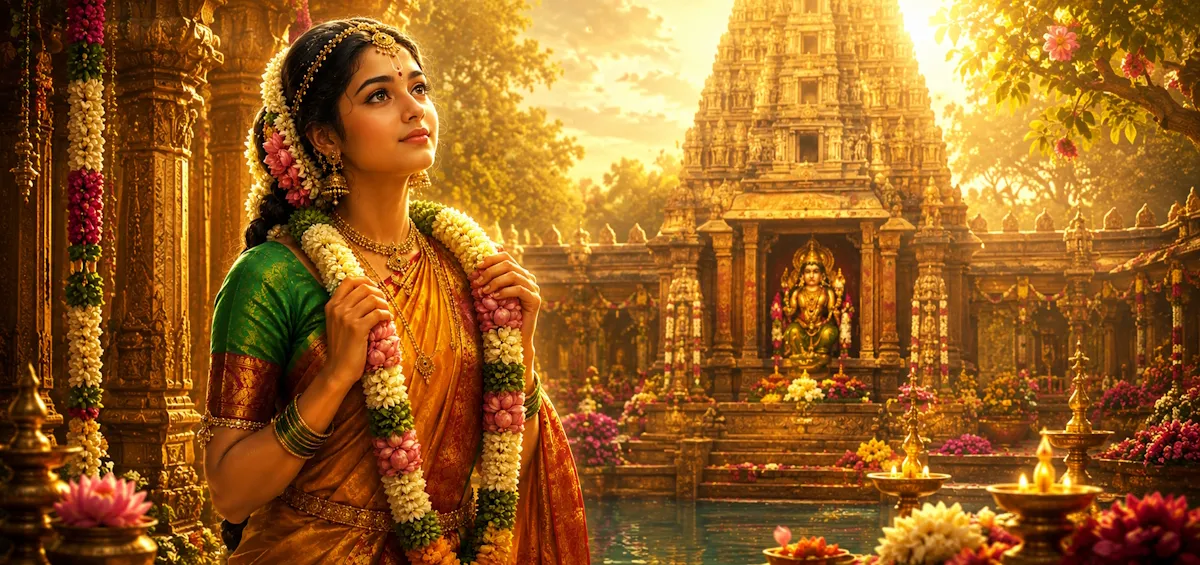
Andal: The Bride of Lord Ranganatha
Andal was found as a baby under a tulsi plant by Vishnuchitta, a devout priest in Srivilliputhur. She grew up deeply in love with Lord Vishnu, imagining herself as his bride and wearing the temple garlands before offering them. Her father was initially angry, but the Lord himself accepted her garlands. She composed the beautiful Thiruppavai and Nachiyar Tirumozi, and eventually merged with Lord Ranganatha in Srirangam.
Characters
In the lush green township of Srivilliputhur, where the air smelled of jasmine and the sound of temple bells rang through the day, there lived a priest named Vishnuchitta. He was known far and wide as Periyalvar, a name that meant the great devotee. Every morning before the sun could paint the sky orange, Vishnuchitta would step out of his little cottage, his bare feet touching the cool earth, and walk to the garden behind the temple. There he grew the most beautiful flowers in the region. Red hibiscus, golden marigolds, fragrant jasmine, and deep blue lilies. He tended to each plant with the same care that a mother gives her child. He sang hymns to them as he watered them, and he believed that the flowers bloomed brighter because they heard the name of the Lord each day.
It was on one such morning, as the stars were just beginning to fade and the first birds were stirring in their nests, that Vishnuchitta heard a sound that made him stop. It was a soft cry. So delicate that he almost mistook it for the wind rustling through the leaves. But he knew the sounds of his garden well. He had never heard anything like this before. He followed the sound, pushing aside the broad leaves of the tulsi plant at the center of the garden. And there, nestled in the shade of the sacred plant, lay a baby girl. Her tiny fists were clenched, her face wet with morning dew, and her eyes looked up at him with a gaze that seemed to pierce right through his soul. Vishnuchitta scooped her up in his trembling arms. He looked around, expecting to see someone, anyone, who might have left her there. But the garden was empty and silent except for the chirping of the sparrows. Tears streamed down his cheeks. He knew in that moment that this was no ordinary child. This was a gift from the Lord himself. He wrapped her in his cotton shawl and carried her home, whispering prayers of gratitude with every step.
He named her Kodai, which meant a garland of flowers, for she had been found among the blossoms. And from that day forward, the little cottage that had once been a quiet home for a solitary priest became a home filled with laughter, with song, and with the pitter-patter of tiny feet. Kodai grew like a flower in that garden of devotion. She watched her father weave garlands for the deity, and before she could even speak properly, she was trying to thread flowers onto a string with her chubby little fingers. When she began to talk, her first words were not mama or papa but the name of the Lord. Vishnuchitta would take her to the temple every day, and she would stand before the idol of Vishnu with her hands folded, her head tilted, staring at the stone figure as if she could see something that no one else could see. The priests noticed that whenever Kodai was in the temple, the oil lamps seemed to burn brighter and the air felt sweeter.
As Kodai grew older, her love for the Lord deepened in a way that surprised everyone. She did not see Vishnu as a distant god in the sky. She saw him as her companion, her friend, and eventually as her beloved husband. In her imagination, she was a princess and he was her king. She would dress up in her mother's old saris, apply sandalwood paste on her forehead, and put flowers in her hair. Then she would stand before the mirror and ask, Am I beautiful enough for him today? Her father would watch her with a mixture of amusement and concern. But he said nothing. He believed that the love of God could take many forms, and who was he to question the way his daughter chose to love?
Every morning, Vishnuchitta would weave a fresh garland for the temple deity. He would select each flower with care, discarding any that had the slightest blemish, murmuring prayers as he strung them together on a thread of cotton. Then he would place the garland in a bamboo basket, cover it with a clean white cloth, and carry it to the temple. What he did not know was that while he was busy with his morning prayers, Kodai would tiptoe into the room where the garland lay, pick it up, and place it on her own head. She would look at herself in the polished brass mirror and imagine that she was wearing this garland for her wedding to the Lord. She would twirl around the room, her little bare feet spinning on the cool stone floor, her heart full of a love so pure that it could only have come from the divine.
Then one morning, Vishnuchitta came back earlier than usual. The garland was gone from the basket. At first he thought a thief had entered his home. But then he heard a soft giggle from the inner room. He parted the curtain and froze. There was his daughter, wearing the sacred garland meant for the Lord, dancing in front of the mirror. His face turned red. He shouted in anger. How dare she touch something that was meant for the deity? Did she not know that once a garland was dedicated to the Lord, no one else could wear it? It was impure now. It was ruined. Kodai stood frozen. The garland slipped from her head and fell to the floor. Tears welled up in her eyes, not because she was afraid, but because her father was so upset. She had not meant any harm. She had only wanted to feel closer to the one she loved. Vishnuchitta picked up the garland, his hands shaking. He did not know what to do. The day passed in heavy silence. Kodai did not eat. She stayed in her room, her heart aching.
That night, as Vishnuchitta lay in his bed, unable to sleep, the Lord appeared to him in a dream. The room was filled with a soft golden light, and the air smelled of a thousand flowers. The Lord spoke, and his voice was like the gentle hum of a conch shell. He said, Why are you angry at my beloved? Do you not know that her love is more precious to me than all the rituals in the world? I do not want the garlands that have not been touched by her. I want only those that she has worn. Her love makes them sacred. Her touch purifies them. From this day, do not wash the garlands she wears. Do not scold her. Bring them to me just as she leaves them. Vishnuchitta woke up with a start, his heart pounding. Tears of joy and shame flowed down his cheeks. He rushed to Kodai's room and held her close. He told her what the Lord had said. She looked at him with those eyes that held no anger, no I told you so. She simply smiled and said, I knew he would accept them. He always does.
From that day, Kodai became known as Andal, meaning the one who rules, for she had won the heart of the Lord himself. She wore the garlands first, and then her father would take them to the temple. The priests were shocked at first. But when they placed the garlands on the deity, the flowers seemed to glow with an otherworldly light. The fragrance that filled the temple was unlike anything anyone had ever smelled. And the Lord looked more beautiful than ever before, as if the garland had brought him to life.
Andal's love could no longer be contained in the small routines of daily life. It overflowed into poetry. During the cold month of Margazhi, when the winter mist hung over the fields and the mornings were dark, Andal would gather the village girls and lead them in singing the Thiruppavai. Thirty verses, each one a call to the Lord to wake up and bless them. They would walk through the streets of Srivilliputhur, their voices rising together in the early dawn, the sound of their singing echoing off the temple walls and reaching up to the heavens. The verses spoke of cows and butter, of love and longing, but beneath each word was the beating heart of a soul that could not live without its beloved. Then she composed the Nachiyar Tirumozi, a longer and more personal poem. In it, she spoke of her dreams, her desires, and her pain. She wrote of how she could not sleep at night because she was thinking of the Lord. She wrote of how the birds and the bees reminded her of him. She wrote of her desperate wish to be united with him. One verse said, I have seen the Lord in my dream. His body was dark like a rain cloud. His eyes were like lotus petals. He held a conch and a discus. And he smiled at me. I cannot live without that smile.
The news of Andal's devotion spread far beyond Srivilliputhur. People came from faraway villages just to hear her sing. Some came to see the girl whose love had moved the Lord. But Andal did not care for fame. She did not care for praise. She cared only for one thing. To be with him. Finally, her father and the temple priests decided that she should be taken to the great temple of Srirangam, where Lord Vishnu resides as Ranganatha, reclining on the serpent Adishesha. When Andal heard this, her heart leaped with joy. She knew. She knew that this was the moment she had been waiting for her entire life.
The journey to Srirangam was like a dream. Andal sat in a palanquin, watching the green fields and the winding rivers pass by. She sang to herself all the way. As they approached the temple, she saw the towering gopurams rising into the sky, covered with thousands of colorful sculptures of gods and goddesses, demons and sages, each one telling a story. The sound of the temple bells reached her ears, and her heart began to beat faster. The priests carried her through the outer gates, past the thousand-pillared halls, past the sacred tank where devotees bathed, and into the inner sanctum. And there she saw him. Lord Ranganatha, lying on the serpent Adishesha, his eyes half closed in eternal peace, a gentle smile on his lips. Andal stepped forward. She did not feel the cold stone under her feet. She did not hear the chanting of the priests. She saw only him. She walked toward the deity, her hands folded, her eyes full of tears of joy. The temple priests prepared for the wedding ceremony. They dressed Andal in a beautiful silk sari of deep red, the color of a bride. They adorned her with gold jewelry and strung fresh flowers in her hair. She looked like a queen, a goddess, a soul made of pure love. As she walked toward the sanctum for the final time, the air grew thick with an unseen presence. The oil lamps flickered. The incense smoke swirled in strange patterns. And then, as Andal stepped forward to offer herself to the Lord, a brilliant light enveloped her. It was not harsh or blinding. It was soft and warm, like the glow of a thousand lamps. In that light, Andal dissolved. Her mortal form melted away, and her soul merged with the idol of Lord Ranganatha. The priests gasped. The devotees fell to their knees. Some wept. Some laughed. Some sat in stunned silence. And high above, the temple bells rang on their own, a joyous celebration of the union between the devotee and the divine.
The story of Andal is not just a story from ancient times. It is a living story. To this day, in Srivilliputhur and Srirangam, her Thiruppavai is sung every December and January during the Margazhi month. Her poems are studied, cherished, and sung in homes and temples across the world. She teaches us that love, when it is pure and complete, cannot be bound by rules or rituals. She teaches us that the Lord responds not to the grandeur of our offerings but to the sincerity of our hearts. And she teaches us that the ultimate purpose of life is not to live for ourselves but to dissolve into the one we love, to become one with the divine, to find our eternal home in the arms of God.
✦Moral of the Story
Pure love and devotion can transform an ordinary human into a beloved of the divine.
The Lord accepts what is offered with true love, even if it breaks the rules of the world.
When you surrender completely to God, you find your true home in his embrace.
Loved This Story?
Read 100+ more sacred Hindu kathas with professional audio narration in both English & हिन्दी on the Tattva app — free, no subscription, no IAP.
Get on Google Play