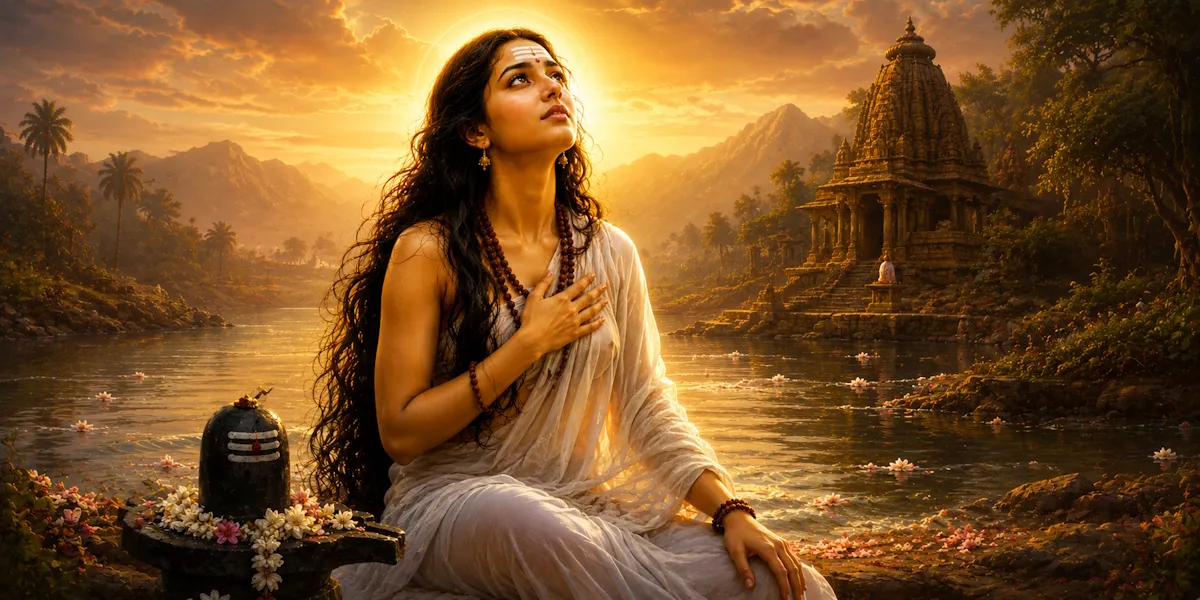
Akka Mahadevi — The Naked Saint of Divine Love
Akka Mahadevi was a 12th century Kannada saint born in Udutadi who was deeply devoted to Lord Shiva as Chenna Mallikarjuna. When King Kaushika became obsessed with her beauty and demanded marriage, she agreed on the condition that he renounce all worldly attachments — a condition he could not meet. She then removed her clothes, covered herself only with her long hair, and wandered to Kalyana where she joined the Sharana movement, debated the wisest philosophers with her profound wisdom, and eventually merged with her beloved Lord in the Kadali forest of Srisailam.
Characters
In the twelfth century, in the lush landscapes of South India, there lived a woman whose love for God burned so intensely that it consumed every worldly attachment. Her name was Mahadevi, but the world would come to know her as Akka Mahadevi — the elder sister of all who sought truth. Her story begins not in a palace or a temple, but on a lonely road where she walked without a single stitch of clothing, her body modestly covered only by her long flowing hair and an even deeper covering of divine love.
People who saw her could not understand. Some laughed. Some threw stones. Some wept at the sight of such complete surrender. But Mahadevi walked on, her eyes turned inward, her lips whispering the name of her beloved Chenna Mallikarjuna. What kind of love could drive a woman to abandon everything, including her very clothes? What kind of devotion could make her fearless in the face of the world's judgment? This is the story of that love.
Mahadevi was born in the small village of Udutadi, hidden among the green hills of the Kannada region. Her parents were simple devout people who noticed something special about their daughter from her earliest days. While other children played with toys, little Mahadevi would collect flowers and tender leaves, arranging them into offerings for the Shiva linga in their home. She spoke to Lord Shiva as if he stood right beside her, sharing her joys, her questions, her innocent heart.
Her mother would often find her sitting alone under a tree, lost in conversation with someone invisible. When asked who she was talking to, Mahadevi would smile and say she was talking to her dearest friend, the one who lived in the temple of her heart. As she grew older, her devotion only deepened. She began composing beautiful poems called Vachanas, pouring her love for Shiva into words that danced with divine energy. She addressed Shiva as Chenna Mallikarjuna, the beautiful Lord as white as jasmine. She called herself his bride, his servant, his child, his lover.
The entire village knew of Mahadevi's singular devotion and respected her for it. But news of her extraordinary beauty spread far beyond Udutadi. Travelers who passed through the village carried tales of a maiden whose face shone like the full moon, whose eyes held the depth of ancient oceans, whose voice could calm a restless heart.
Word of Mahadevi's beauty reached the court of King Kaushika, a powerful ruler whose kingdom lay not far from Udutadi. King Kaushika was a man accustomed to getting whatever he desired. His treasury overflowed with gold. His armies were feared across the land. His palace was filled with luxuries from distant kingdoms. But he had never seen a woman like Mahadevi.
One day the king rode to Udutadi with his royal procession. The villagers bowed low as the king passed, wondering what business a monarch could have in their humble village. When King Kaushika saw Mahadevi, he was struck speechless. Her beauty was unlike anything he had ever witnessed. But more than her physical beauty, it was the light in her eyes that captured him — a serene unshakeable peace that he with all his wealth and power had never known.
The king sent his ministers to Mahadevi's home with grand proposals. They spoke of palaces and silks, of jewels and servants, of a life of luxury as the queen of a prosperous kingdom. Mahadevi listened patiently. Then she gave her answer.
She agreed to marry the king, but on one condition. The king must give up all attachment to worldly things. He must abandon his wealth, his kingdom, his armies, his throne. He must become a wandering ascetic, owning nothing, desiring nothing, attached to nothing. Only then would she become his wife.
The ministers were stunned. They carried this strange condition back to the king. Kaushika laughed at first, thinking it was a joke. But when he realized Mahadevi was serious, his laughter turned to anger. How dare a village girl make such demands of a king? He stormed to her home himself, demanding an explanation.
Mahadevi looked at the king with compassion. She said that if he truly loved her, he must understand what love really meant. Love was not about possessing another person. Love was not about filling a void with wealth or status. True love meant freeing oneself from all attachments, including the very desire to possess. If he could let go of everything for her, then she would know his love was real.
The king could not understand her words. His mind was too clouded by pride and desire. He offered her half his kingdom. He offered to build her the grandest temple. He offered to shower her with riches beyond imagination. But Mahadevi shook her head gently. She wanted none of these things. She wanted only what she already had — the boundless love of Chenna Mallikarjuna.
Realizing that the king would never leave her alone, Mahadevi made a decision that would shock the world. She took off the fine clothes she wore. She removed her ornaments and jewelry. She let her hair loose, and it fell around her like a dark river covering her body. Then without a single garment on her skin, she walked out of her home and began her journey.
Her parents wept and begged her to stay. The villagers gathered to stare in disbelief. Some covered their eyes in shame. Others called her mad. But Mahadevi walked on, her steps steady, her face peaceful. She was not trying to shock anyone. She was simply discarding what she no longer needed. If her body was the temple of Shiva, she reasoned, then why should it need coverings? Her beloved Chenna Mallikarjuna saw her as she truly was, and that was all that mattered.
And so began her incredible journey to Kalyana, the great city where the revolutionary Sharana movement was flourishing under the guidance of Basavanna, Allama Prabhu, and other spiritual giants. The road to Kalyana was long and dangerous. It wound through dense forests where tigers prowled and snakes lay hidden. It crossed rivers that swelled with monsoon rains. It passed through villages where people stared at the naked woman and whispered cruel things.
But Mahadevi was not afraid. She sang her Vachanas as she walked, her voice rising like a lark into the open sky. Sometimes she laughed with joy. Sometimes she wept with longing. But always, her mind was fixed on her beloved. Wild animals who crossed her path seemed to sense something sacred about her. The tigers turned away. The snakes slithered aside. The rain fell around her like a blessing.
In the villages, reactions were mixed. Children ran after her, laughing and pointing. Some women threw stones at her, calling her a madwoman and a disgrace. But there were also those who saw something divine in her eyes. Old women would approach her with tears in their eyes, touching her feet. Farmers would offer her fruits and water. Once a young mother whose child was ill brought the baby to Mahadevi. Mahadevi placed her hand on the child's forehead and whispered a prayer. The child's fever broke that very night.
Mahadevi never stopped to teach or preach. She simply lived her truth, and that truth spoke louder than any sermon. Her body grew thin from the hardships of the road. Her feet became cracked and bleeding from walking on rough paths. But her spirit remained unbroken, blazing with the fire of divine love.
Finally after many weeks, she reached Kalyana. The city was buzzing with spiritual activity. Basavanna had created a gathering place where people from all castes and backgrounds came together to debate philosophy, share their devotion, and seek the truth. The Anubhava Mantapa, the hall of spiritual experience, was the heart of this movement.
When Mahadevi entered the city, a crowd gathered around her. Some were scandalized by her appearance. Others were moved to tears. Word spread quickly that a naked woman was approaching the Anubhava Mantapa. The great saints and philosophers prepared to receive her, or to test her.
Inside the Anubhava Mantapa, the wisest minds of the age sat in a circle. Basavanna, the visionary leader, watched with quiet interest. Allama Prabhu, the sharp-witted sage, prepared his questions. Other saints and seekers filled the hall, eager to see what this strange woman would say.
Mahadevi walked in, her hair flowing behind her, her eyes bright with divine intoxication. She did not bow to anyone. She did not ask for permission. She stood in the center of the circle and simply looked around, a gentle smile on her face.
Allama Prabhu was the first to speak. He asked her a question designed to test her understanding. He said that if she had truly renounced everything, then why did she still carry this burden of hair. Why did she cover herself with it. Was that not also a form of attachment.
The hall fell silent. It was a clever question, one that would trap an ordinary person. But Mahadevi was no ordinary person. She laughed, a sound like ringing bells. She said that if Allama Prabhu could see her hair as a burden, then he was still seeing with worldly eyes. She was not covering herself. She was simply being. Her hair was as natural to her as her arms or her legs. It was the king and the people who made it a symbol of shame or beauty. She had transcended all such symbols.
Then she challenged them all. She asked them what they had truly given up. They wore clothes, ate food, lived in shelters, and called themselves renunciates. But had they given up the desire for respect. Had they given up the need to be seen as holy. Had they given up the subtle pride that came with spiritual knowledge.
Her words cut through the air like a sword. One by one, the saints bowed their heads. They said that she was not their student. She was their sister. She had taught them all that day.
From that day on, she was known as Akka Mahadevi, which meant Sister Mahadevi. She stayed in Kalyana for some time, participating in the gatherings, composing more Vachanas, and touching the lives of everyone she met. But her heart was never truly at rest. She longed for the day when she would be united with her beloved Chenna Mallikarjuna forever.
Mahadevi felt a call from deep within. She knew it was time for the final stage of her journey. She left Kalyana and began walking south, toward the sacred hills of Srisailam. The Kadali forest that surrounded the ancient temple of Mallikarjuna was said to be a place where the veil between the human and the divine was thin.
The journey was harder than before. Her body was weaker now, worn down by years of wandering. But her spirit burned brighter than ever. As she entered the Kadali forest, the trees seemed to bow before her. The air grew thick with the scent of jasmine and sandalwood. She could feel the presence of her beloved growing stronger with every step.
She found a quiet spot near a stream, where wild flowers grew in abundance and the sound of water created a natural music. There she sat down, her back against an ancient tree, her eyes fixed on the horizon. She began to meditate, her lips moving silently with the name of Chenna Mallikarjuna.
Days passed. A week. Perhaps longer. The local villagers who discovered her brought her food and water, but she barely touched them. She was slowly slipping away from this world, dissolving into the divine love that had always been her true home.
On the final day, a soft smile spread across her face. A gentle breeze carried her hair like a blessing. She opened her eyes one last time, and those who were there said that her eyes held the light of a thousand suns. She whispered the name of her beloved. And then she was gone.
They say that a brilliant light emerged from her body and rose into the sky, merging with the infinite. Her physical form remained, but it was no longer Mahadevi. It was a shrine, a reminder of what happens when a soul loves completely, unconditionally, without reservation.
The life of Akka Mahadevi teaches us that true freedom comes not from possessing everything, but from needing nothing. She showed the world that love for the divine can be so powerful that it strips away all fear, all shame, all attachment. Her story reminds us that when we strip away everything we think we need, we often discover that what remains is the only thing that truly matters — the eternal unconditional love that connects us to the source of all existence.
✦Moral of the Story
True freedom comes not from possessing everything but from needing nothing
Divine love has the power to strip away all fear, shame, and worldly attachment
The ultimate spiritual journey is that of complete surrender to the divine
Loved This Story?
Read 100+ more sacred Hindu kathas with professional audio narration in both English & हिन्दी on the Tattva app — free, no subscription, no IAP.
Get on Google Play