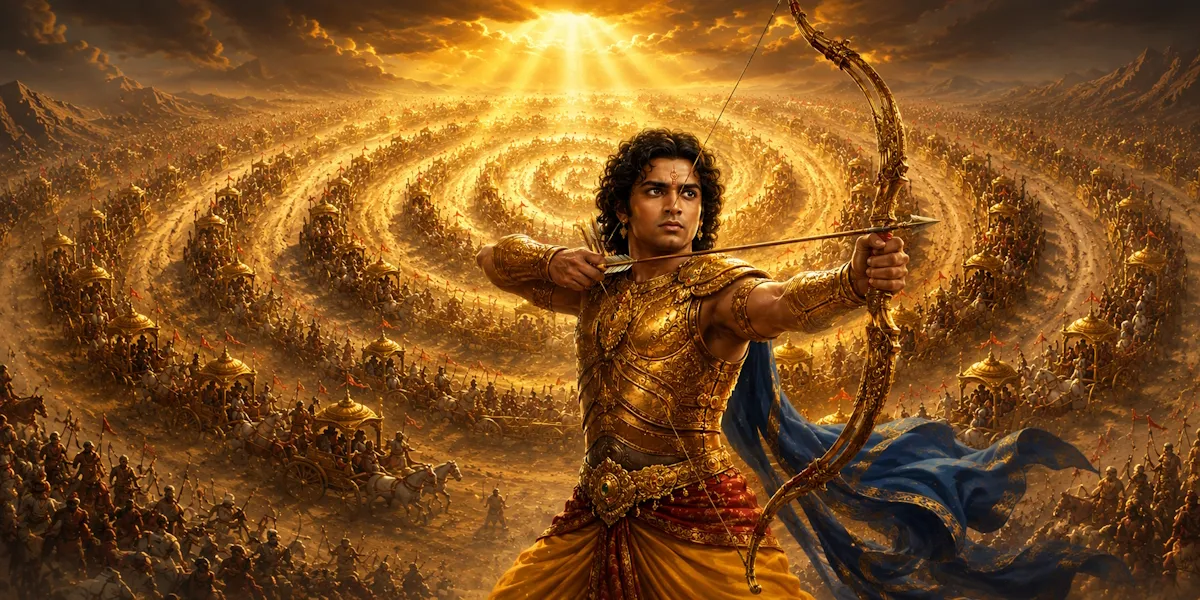
Abhimanyu and the Chakravyuha
The story of sixteen-year-old Abhimanyu, who bravely enters the deadly Chakravyuha formation on the thirteenth day of the Mahabharata war. Though he knows how to enter from hearing Arjuna's lessons while in his mother's womb, he does not know how to exit, and faces six great warriors alone. His courageous sacrifice awakens Arjuna's wrath and becomes one of the most legendary tales of bravery in Hindu mythology.
Characters
The thirteenth day of the great Mahabharata war dawned with an eerie silence. The battlefield of Kurukshetra, which had witnessed the clash of weapons for twelve long days and nights, seemed to hold its breath. In the Kaurava camp, something terrible was being prepared.
Dronacharya, the great teacher of both the Pandavas and the Kauravas, stood before Duryodhana with a plan. His voice was calm, but his eyes carried the weight of what he was about to propose. Today, he said, the Kauravas would form the Chakravyuha. A spiral battle formation so deadly that only the greatest warriors could even dream of entering it. Only two people in the entire world knew how to break it. Krishna and Arjuna. And on this day, both of them would be far away.
Duryodhana smiled with cruel satisfaction. He had already arranged for the Samshaptakas to challenge Arjuna to a separate battle, far from the main formation. Krishna, bound to Arjuna as his charioteer, would have to go with him. The trap was set.
On the Pandava side of the battlefield, the soldiers watched in horror as the Kaurava army arranged itself into a massive spiral. Layer after layer of warriors, each ring guarded by fearsome generals. At the outermost entrance stood Jayadratha, the king of Sindhu. Lord Shiva had blessed Jayadratha with a boon that for one single day, he could hold back all the Pandavas except Arjuna.
Yudhishthira called his brothers together. His face was pale, and his voice trembled with worry. Without Arjuna, he said, they could not break this formation. But if they did nothing, Duryodhana would claim victory and the war would be lost.
Bhima stepped forward, pounding his massive fist into his palm. Let him enter, he roared. He would smash through each layer with his bare hands if needed. But Krishna shook his head gently. The Chakravyuha could not be broken by force alone. One had to know the path through its winding corridors. One wrong turn meant certain death.
Just then, a young voice spoke from behind them. I know how to enter the Chakravyuha.
Everyone turned. It was Abhimanyu, the sixteen-year-old son of Arjuna and Subhadra. His face was calm, but his eyes burned with quiet determination. He was tall for his age, with broad shoulders and a gentle smile that reminded everyone of his father. Around his neck hung a golden locket that Subhadra had given him, a mother's blessing for protection.
Yudhishthira looked at the boy with surprise and affection. You know how to enter, child? he asked. But do you know how to exit?
Abhimanyu hesitated. The memory of his mother's story came rushing back to him. Before he was born, while he was still in his mother's womb, his father Arjuna had explained the secrets of the Chakravyuha to Subhadra. Abhimanyu had heard every word about how to enter. But Subhadra had fallen asleep before Arjuna could explain how to escape. So Abhimanyu was born knowing only half the secret.
I do not know how to exit, he admitted quietly. Mother fell asleep before Father could finish.
A heavy silence fell over the Pandava council. Yudhishthira's eyes filled with tears. Then I cannot send you, my son, he said softly. You are like a son to me. If something happened to you, your father would never forgive me.
But Abhimanyu stepped forward and knelt before his uncle. King Yudhishthira, he said, his voice steady, my father would never forgive himself if he learned that his son had the courage to fight but chose to run away. Let me enter the Chakravyuha. The Pandava warriors can follow behind me and protect my path.
Krishna walked over to Abhimanyu and placed his hand on the boy's shoulder. His divine eyes held a deep sadness, for he could see what was to come. You know what this means, Krishna said softly.
Abhimanyu nodded. I know, he replied. But a warrior's duty is greater than his life.
Tears rolled down Yudhishthira's cheeks. He embraced the boy tightly, then gave the order. The Pandava army would advance. Abhimanyu would lead the charge into the Chakravyuha, and the greatest warriors of the Pandava army would follow right behind him, smashing a path through the Kaurava ranks.
Abhimanyu climbed into his chariot. His charioteer, a loyal soldier named Sumitra, held the reins with trembling hands. Are you afraid, young prince? Sumitra asked.
Abhimanyu strung his bow and tested the string. The sound was sharp and clear, like a bird's call at dawn. I am afraid, he admitted. But fear is not a reason to turn back.
He raised his bow high and shouted his war cry. The sound echoed across the battlefield like thunder rolling over the mountains. His horses surged forward, galloping at full speed toward the massive spiral of the Chakravyuha.
The first layer opened before him. Kaurava warriors rushed at him from all sides. Their swords flashed in the morning sun. Their arrows darkened the sky. But Abhimanyu's bow sang a deadly song. His arrows flew with impossible speed and accuracy, finding their marks in the hearts of his enemies. He shot down soldiers, wounded charioteers, and felled elephants as if they were practice targets made of straw.
The Kaurava soldiers could not believe their eyes. This boy moved like water, like wind, like fire. His chariot wove through the narrow passages of the formation. He knew exactly where each turn would lead. His knowledge, learned in the quiet darkness of his mother's womb, guided him perfectly through every layer.
The second layer fell. The third. The fourth. Each ring of the spiral was more dangerous than the last, and each time, Abhimanyu rose to meet the challenge. His arms moved without rest. His bowstring hummed like a swarm of angry bees. Sweat covered his face, and dust caked his armor, but he did not stop.
Behind him, the Pandava army tried desperately to follow. Bhima smashed through Kaurava soldiers with his massive mace, clearing a path. Yudhishthira commanded the archers to provide cover. Nakula and Sahadeva fought side by side, protecting their brothers' flanks. But at the entrance, Jayadratha stood like an immovable mountain. True to his boon, he held back the Pandava forces with sheer determination and the divine blessing of Lord Shiva. One by one, the Pandava warriors found themselves blocked, unable to enter the formation.
Inside the Chakravyuha, Abhimanyu fought on, unaware that he was now completely alone.
In the fifth layer, he faced Kritavarma, a mighty warrior of the Yadava clan. Kritavarma laughed when he saw the young boy approaching. You are barely old enough to hold a bow, child, he mocked. Go home to your mother.
Abhimanyu answered with an arrow that struck the flag from Kritavarma's chariot. His aim was so perfect, so precise, that the laughter died in Kritavarma's throat. The two exchanged a storm of arrows. Abhimanyu's bow moved so fast that his hands seemed to blur. He struck Kritavarma's chariot horses, wounding them, and forced the great warrior to retreat in shame.
The sixth layer was guarded by Shakuni's son and hundreds of Kaurava soldiers. They surrounded Abhimanyu's chariot from every side. But Abhimanyu leaped to the ground, drawing his sword and shield. He moved through the enemy soldiers like a dancer, his blade flashing in the sunlight. Each strike was clean and true. He did not fight with hatred. He fought with the calm focus of a warrior performing his sacred duty.
By the time he reached the innermost layers, Abhimanyu had defeated thousands of soldiers. His body was covered in wounds. His armor was broken in several places. His horses were exhausted and bleeding. But his spirit remained unbroken. He climbed back into his chariot and pressed forward.
At the heart of the Chakravyuha, the greatest warriors of the Kaurava army waited for him. Dronacharya stood at the center, his white beard stained with dust. Beside him stood Karna, the son of the sun god, his golden armor gleaming. Ashwatthama, the son of Dronacharya, held his mace ready. Shalya, the king of Madra, sat in his chariot with a grim expression. And many other fearsome warriors formed a circle around the young boy.
Dronacharya looked at Abhimanyu with sorrow in his eyes. This was the son of his favorite student, Arjuna. A child he had once bounced on his knee. And now, fate had brought them to this moment.
You have fought well, boy, Dronacharya said, his voice heavy with emotion. No one has ever penetrated this deep into the Chakravyuha. You have earned the respect of every warrior here today. But this is where your journey must end.
Abhimanyu did not answer with words. He answered with his bow. He loosed arrow after arrow, driving back even the greatest warriors. His arrows forced Karna to defend himself. They made Ashwatthama raise his shield. They struck Dronacharya's bow and made the old guru stumble. For a few glorious moments, it seemed as though Abhimanyu might actually prevail.
But then Dronacharya gave the order. Six warriors attacked at once. Dronacharya, Karna, Ashwatthama, Kritavarma, Shakuni's son, and the king of Madra surrounded Abhimanyu from every direction and struck simultaneously.
Abhimanyu's shield shattered into pieces. His bow was cut in half. His chariot was destroyed beneath him. He fell to the ground, wounded and weaponless. But even then, he did not surrender. He picked up a broken chariot wheel and held it above his head as a shield. He continued to fight, advancing step by step, his spirit blazing brighter than any sword.
One by one, the great warriors struck him. Arrow after arrow found its mark. Wound after wound covered his body. But Abhimanyu did not cry out. He did not beg for mercy. He did not fall to his knees and plead for his life. He held the chariot wheel high and kept moving forward.
The entire battlefield grew quiet. Warriors on both sides stopped fighting to watch. The sun hid behind a cloud. The wind stopped blowing. It was as if the universe itself paused to honor the courage of this sixteen-year-old boy.
Finally, with his last ounce of strength, Abhimanyu fell. He collapsed onto the ground, his blood soaking the earth of Kurukshetra. His eyes, still bright with the fire of youth, looked up at the sky one last time. A gentle smile crossed his face. He had done his duty. He had fought with everything he had. He had honored his father's name and his mother's love.
And then he was gone.
The Chakravyuha stopped moving. The Kaurava warriors stood in stunned silence. There was no cheering, no celebration. Even Duryodhana, cruel as he was, could not find words. They had killed a child. A child who had fought like a hundred lions.
Karna lowered his head in shame. Ashwatthama wept openly. Dronacharya turned away, unable to look at the fallen boy. A great warrior had fallen, and they all knew it.
When the news reached Arjuna on the distant battlefield, he collapsed to his knees. His son. His brave, beautiful, gentle son was gone. Tears streamed down his face as Krishna held him. Krishna's own eyes were wet, for he had loved Abhimanyu like his own child.
Then Arjuna's grief turned into a fire, a righteous fury that burned through his entire being. He vowed before the gods that he would kill Jayadratha before sunset the next day, or he would throw himself into the fire. And with Krishna's guidance, Arjuna fulfilled his vow, cutting through the Kaurava army like a storm and ending Jayadratha's life.
But the death of Abhimanyu changed everything. It reminded every warrior on the battlefield what this war was truly about. It hardened the Pandavas' resolve. And it gave the world a story of courage that would be told for thousands of years.
Abhimanyu's life was short. He was only sixteen years old. But in those sixteen years, he learned what it meant to be a warrior. He learned that courage is not the absence of fear. It is the willingness to act despite fear. He learned that duty is more important than safety. And he learned that a single life, lived with honor and bravery, can illuminate the darkness for generations to come.
His name is still remembered. His courage is still celebrated. And his story, the story of the boy who entered the Chakravyuha knowing he might never return, continues to inspire everyone who hears it.
Because true heroes are not measured by how long they live. They are measured by how fully they live, how bravely they face their challenges, and how selflessly they give themselves for others. By that measure, Abhimanyu was one of the greatest heroes who ever lived.
The lessons of Abhimanyu's story are timeless. First, true courage is not the absence of fear, but the willingness to do what is right despite knowing the risks. Second, knowledge without complete understanding can lead to unforeseen consequences. And third, even in defeat, one can achieve immortal glory through bravery and sacrifice.
As the sun sets on the battlefield of Kurukshetra, the spirit of young Abhimanyu reminds us that the deepest impact is not made by those who live the longest, but by those who live the bravest.
✦Moral of the Story
True courage is not the absence of fear, but the willingness to do what is right despite knowing the risks
Knowledge without complete understanding can lead to unforeseen consequences
Even in defeat, one can achieve immortal glory through bravery and sacrifice
Loved This Story?
Read 100+ more sacred Hindu kathas with professional audio narration in both English & हिन्दी on the Tattva app — free, no subscription, no IAP.
Get on Google Play